 |
deal.II version GIT relicensing-6842-g793a97d2aa 2026-10-02 14:00:01+00:00
|
Loading...
Searching...
No Matches
|
deal.II version GIT relicensing-6842-g793a97d2aa 2026-10-02 14:00:01+00:00
|
#include <deal.II/fe/fe.h>
This is the base class for finite elements in arbitrary dimensions. It declares the interface both in terms of member variables and public member functions through which properties of a concrete implementation of a finite element can be accessed. This interface generally consists of a number of groups of variables and functions that can roughly be delineated as follows:
The following sections discuss many of these concepts in more detail, and outline strategies by which concrete implementations of a finite element can provide the details necessary for a complete description of a finite element space.
As a general rule, there are three ways by which derived classes provide this information:
Finite element classes have to define a large number of different properties describing a finite element space. The following subsections describe some nomenclature that will be used in the documentation below.
Vector-valued finite element are elements used for systems of partial differential equations. Oftentimes, they are composed via the FESystem class (which is itself derived from the current class), but there are also non-composed elements that have multiple components (for example the FE_Nedelec and FE_RaviartThomas classes, among others). For any of these vector valued elements, individual shape functions may be nonzero in one or several components of the vector valued function. If the element is primitive, there is indeed a single component with a nonzero entry for each shape function. This component can be determined using the FiniteElement::system_to_component_index() function.
On the other hand, if there is at least one shape function that is nonzero in more than one vector component, then we call the entire element "non-primitive". The FiniteElement::get_nonzero_components() can then be used to determine which vector components of a shape function are nonzero. The number of nonzero components of a shape function is returned by FiniteElement::n_components(). Whether a shape function is non-primitive can be queried by FiniteElement::is_primitive().
Oftentimes, one may want to split linear system into blocks so that they reflect the structure of the underlying operator. This is typically not done based on vector components, but based on the use of blocks, and the result is then used to substructure objects of type BlockVector, BlockSparseMatrix, and so on. If you use non-primitive elements, you cannot determine the block number by FiniteElement::system_to_component_index(). Instead, you can use FiniteElement::system_to_block_index(). The number of blocks of a finite element can be determined by FiniteElement::n_blocks().
To better illustrate these concepts, let's consider the following example of the multi-component system
with dim=2. The resulting finite element has 3 components: two that come from the quadratic element and one from the linear element. If, for example, this system were used to discretize a problem in fluid dynamics then one could think of the first two components representing a vector-valued velocity field whereas the last one corresponds to the scalar pressure field. Without degree-of-freedom (DoF) renumbering this finite element will produce the following distribution of local DoFs:
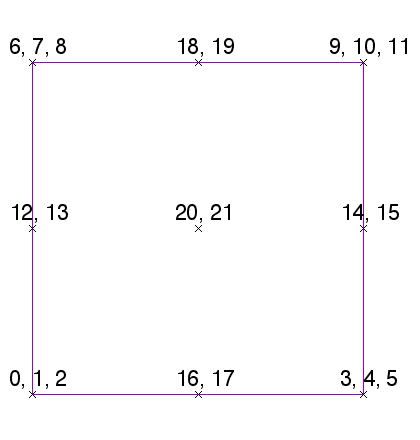
Using the two functions FiniteElement::system_to_component_index() and FiniteElement::system_to_base_index() one can get the following information for each degree-of-freedom "i":
which will result in:
| DoF | Component | Base element | Shape function within base | Multiplicity |
|---|---|---|---|---|
| 0 | 0 | 0 | 0 | 0 |
| 1 | 1 | 0 | 0 | 1 |
| 2 | 2 | 1 | 0 | 0 |
| 3 | 0 | 0 | 1 | 0 |
| 4 | 1 | 0 | 1 | 1 |
| 5 | 2 | 1 | 1 | 0 |
| 6 | 0 | 0 | 2 | 0 |
| 7 | 1 | 0 | 2 | 1 |
| 8 | 2 | 1 | 2 | 0 |
| 9 | 0 | 0 | 3 | 0 |
| 10 | 1 | 0 | 3 | 1 |
| 11 | 2 | 1 | 3 | 0 |
| 12 | 0 | 0 | 4 | 0 |
| 13 | 1 | 0 | 4 | 1 |
| 14 | 0 | 0 | 5 | 0 |
| 15 | 1 | 0 | 5 | 1 |
| 16 | 0 | 0 | 6 | 0 |
| 17 | 1 | 0 | 6 | 1 |
| 18 | 0 | 0 | 7 | 0 |
| 19 | 1 | 0 | 7 | 1 |
| 20 | 0 | 0 | 8 | 0 |
| 21 | 1 | 0 | 8 | 1 |
What we see is the following: there are a total of 22 degrees-of-freedom on this element with components ranging from 0 to 2. Each DoF corresponds to one of the two base elements used to build FESystem : \(\mathbb Q_2\) or \(\mathbb Q_1\). Since FE_Q are primitive elements, we have a total of 9 distinct scalar-valued shape functions for the quadratic element and 4 for the linear element. Finally, for DoFs corresponding to the first base element multiplicity is either zero or one, meaning that we use the same scalar valued \(\mathbb Q_2\) for both \(x\) and \(y\) components of the velocity field \(\mathbb Q_2 \otimes \mathbb Q_2\). For DoFs corresponding to the second base element multiplicity is zero.
Finite elements are frequently defined by defining a polynomial space and a set of dual functionals. If these functionals involve point evaluations, then the element is "interpolatory" and it is possible to interpolate an arbitrary (but sufficiently smooth) function onto the finite element space by evaluating it at these points. We call these points "support points".
Most finite elements are defined by mapping from the reference cell to a concrete cell. Consequently, the support points are then defined on the reference ("unit") cell, see this glossary entry. The support points on a concrete cell can then be computed by mapping the unit support points, using the Mapping class interface and derived classes, typically via the FEValues class.
A typical code snippet to do so would look as follows:
Alternatively, the points can be transformed one-by-one:
The following sections provide some more guidance for implementing concrete finite element spaces in derived classes. This includes information that depends on the dimension for which you want to provide something, followed by a list of tools helping to generate information in concrete cases.
It is important to note that there is a number of intermediate classes that can do a lot of what is necessary for a complete description of finite element spaces. For example, the FE_Poly, FE_PolyTensor, and FE_PolyFace classes in essence build a complete finite element space if you only provide them with an abstract description of the polynomial space upon which you want to build an element. Using these intermediate classes typically makes implementing finite element descriptions vastly simpler.
As a general rule, if you want to implement an element, you will likely want to look at the implementation of other, similar elements first. Since many of the more complicated pieces of a finite element interface have to do with how they interact with mappings, quadrature, and the FEValues class, you will also want to read through the How Mapping, FiniteElement, and FEValues work together documentation topic.
In one space dimension (i.e., for dim==1 and any value of spacedim), finite element classes implementing the interface of the current base class need only set the restriction and prolongation matrices that describe the interpolation of the finite element space on one cell to that of its parent cell, and to that on its children, respectively. The constructor of the current class in one dimension presets the interface_constraints matrix (used to describe hanging node constraints at the interface between cells of different refinement levels) to have size zero because there are no hanging nodes in 1d.
In addition to the fields discussed above for 1d, a constraint matrix is needed to describe hanging node constraints if the finite element has degrees of freedom located on edges or vertices. These constraints are represented by an \(m\times n\)-matrix interface_constraints, where m is the number of degrees of freedom on the refined side without the corner vertices (those dofs on the middle vertex plus those on the two lines), and n is that of the unrefined side (those dofs on the two vertices plus those on the line). The matrix is thus a rectangular one. The \(m\times n\) size of the interface_constraints matrix can also be accessed through the interface_constraints_size() function.
The mapping of the dofs onto the indices of the matrix on the unrefined side is as follows: let \(d_v\) be the number of dofs on a vertex, \(d_l\) that on a line, then \(n=0...d_v-1\) refers to the dofs on vertex zero of the unrefined line, \(n=d_v...2d_v-1\) to those on vertex one, \(n=2d_v...2d_v+d_l-1\) to those on the line.
Similarly, \(m=0...d_v-1\) refers to the dofs on the middle vertex of the refined side (vertex one of child line zero, vertex zero of child line one), \(m=d_v...d_v+d_l-1\) refers to the dofs on child line zero, \(m=d_v+d_l...d_v+2d_l-1\) refers to the dofs on child line one. Please note that we do not need to reserve space for the dofs on the end vertices of the refined lines, since these must be mapped one-to-one to the appropriate dofs of the vertices of the unrefined line.
Through this construction, the degrees of freedom on the child faces are constrained to the degrees of freedom on the parent face. The information so provided is typically consumed by the DoFTools::make_hanging_node_constraints() function.
For the interface constraints, the 3d case is similar to the 2d case. The numbering for the indices \(n\) on the parent face is obvious and keeps to the usual numbering of degrees of freedom on quadrilaterals.
The numbering of the degrees of freedom on the interior of the refined faces for the index \(m\) is as follows: let \(d_v\) and \(d_l\) be as above, and \(d_q\) be the number of degrees of freedom per quadrilateral (and therefore per face), then \(m=0...d_v-1\) denote the dofs on the vertex at the center, \(m=d_v...5d_v-1\) for the dofs on the vertices at the center of the bounding lines of the quadrilateral, \(m=5d_v..5d_v+4*d_l-1\) are for the degrees of freedom on the four lines connecting the center vertex to the outer boundary of the parent face, \(m=5d_v+4*d_l...5d_v+4*d_l+8*d_l-1\) for the degrees of freedom on the small lines surrounding the quad, and \(m=5d_v+12*d_l...5d_v+12*d_l+4*d_q-1\) for the dofs on the four child faces. Note the direction of the lines at the boundary of the quads, as shown below.
The order of the twelve lines and the four child faces can be extracted from the following sketch, where the overall order of the different dof groups is depicted:
*    *--15--4--16--*
*    |      |      |
*    10 19  6  20  12
*    |      |      |
*    1--7---0--8---2
*    |      |      |
*    9  17  5  18  11
*    |      |      |
*    *--13--3--14--*
*
The numbering of vertices and lines, as well as the numbering of children within a line is consistent with the one described in Triangulation. Therefore, this numbering is seen from the outside and inside, respectively, depending on the face.
The three-dimensional case has a few pitfalls available for derived classes that want to implement constraint matrices. Consider the following case:
*          *-------*
*         /       /|
*        /       / |
*       /       /  |
*      *-------*   |
*      |       |   *-------*
*      |       |  /       /|
*      |   1   | /       / |
*      |       |/       /  |
*      *-------*-------*   |
*      |       |       |   *
*      |       |       |  /
*      |   2   |   3   | /
*      |       |       |/
*      *-------*-------*
*
Now assume that we want to refine cell 2. We will end up with two faces with hanging nodes, namely the faces between cells 1 and 2, as well as between cells 2 and 3. Constraints have to be applied to the degrees of freedom on both these faces. The problem is that there is now an edge (the top right one of cell 2) which is part of both faces. The hanging node(s) on this edge are therefore constrained twice, once from both faces. To be meaningful, these constraints of course have to be consistent: both faces have to constrain the hanging nodes on the edge to the same nodes on the coarse edge (and only on the edge, as there can then be no constraints to nodes on the rest of the face), and they have to do so with the same weights. This is sometimes tricky since the nodes on the edge may have different local numbers.
For the constraint matrix this means the following: if a degree of freedom on one edge of a face is constrained by some other nodes on the same edge with some weights, then the weights have to be exactly the same as those for constrained nodes on the three other edges with respect to the corresponding nodes on these edges. If this isn't the case, you will get into trouble with the AffineConstraints class that is the primary consumer of the constraint information: while that class is able to handle constraints that are entered more than once (as is necessary for the case above), it insists that the weights are exactly the same.
Using this scheme, child face degrees of freedom are constrained against parent face degrees of freedom that contain those on the edges of the parent face; it is possible that some of them are in turn constrained themselves, leading to longer chains of constraints that the AffineConstraints class will eventually have to sort out. (The constraints described above are used by the DoFTools::make_hanging_node_constraints() function that constructs an AffineConstraints object.) However, this is of no concern for the FiniteElement and derived classes since they only act locally on one cell and its immediate neighbor, and do not see the bigger picture. The hp_paper details how such chains are handled in practice.
Construction of a finite element and computation of the matrices described above is often a tedious task, in particular if it has to be performed for several dimensions. Most of this work can be avoided by using the intermediate classes already mentioned above (e.g., FE_Poly, FE_PolyTensor, etc). Other tasks can be automated by some of the functions in namespace FETools.
First, it may already be difficult to compute the basis of shape functions for arbitrary order and dimension. On the other hand, if the node values are given, then the duality relation between node functionals and basis functions defines the basis. As a result, the shape function space may be defined from a set of linearly independent functions, such that the actual finite element basis is computed from linear combinations of them. The coefficients of these combinations are determined by the duality of node values and form a matrix.
Using this matrix allows the construction of the basis of shape functions in two steps.
Define the space of shape functions using an arbitrary basis wj and compute the matrix M of node functionals Ni applied to these basis functions, such that its entries are mij = Ni(wj).
The matrix M may be computed with FETools::compute_node_matrix(). This function relies on the existence of generalized_support_points and FiniteElement::convert_generalized_support_point_values_to_dof_values() (see the glossary entry on generalized support points for more information). With this, one can then use the following piece of code in the constructor of a class derived from FiniteElement to compute the \(M\) matrix:
Don't forget to make sure that unit_support_points or generalized_support_points are initialized before this!
Once you have shape functions, you can define matrices that transfer data from one cell to its children or the other way around. This is a common operation in multigrid, of course, but is also used when interpolating the solution from one mesh to another after mesh refinement, as well as in the definition of some error estimators.
To define the prolongation matrices, i.e., those matrices that describe the transfer of a finite element field from one cell to its children, implementations of finite elements can either fill the prolongation array by hand, or can call FETools::compute_embedding_matrices().
In the latter case, all that is required is the following piece of code:
As in this example, prolongation is almost always implemented via embedding, i.e., the nodal values of the function on the children may be different from the nodal values of the function on the parent cell, but as a function of \(\mathbf x\in{\mathbb R}^\text{spacedim}\), the finite element field on the child is the same as on the parent.
The opposite operation, restricting a finite element function defined on the children to the parent cell is typically implemented by interpolating the finite element function on the children to the nodal values of the parent cell. In deal.II, the restriction operation is implemented as a loop over the children of a cell that each apply a matrix to the vector of unknowns on that child cell (these matrices are stored in restriction and are accessed by get_restriction_matrix()). The operation that then needs to be implemented turns out to be surprisingly difficult to describe, but is instructive to describe because it also defines the meaning of the restriction_is_additive_flags array (accessed via the restriction_is_additive() function).
To give a concrete example, assume we use a \(Q_1\) element in 1d, and that on each of the parent and child cells degrees of freedom are (locally and globally) numbered as follows:
Then we want the restriction operation to take the value of the zeroth DoF on child 0 as the value of the zeroth DoF on the parent, and take the value of the first DoF on child 1 as the value of the first DoF on the parent. Ideally, we would like to write this follows
\[ U^\text{coarse}|_\text{parent} = \sum_{\text{child}=0}^1 R_\text{child} U^\text{fine}|_\text{child} \]
where \(U^\text{fine}|_\text{child=0}=(U^\text{fine}_0,U^\text{fine}_1)^T\) and \(U^\text{fine}|_\text{child=1}=(U^\text{fine}_1,U^\text{fine}_2)^T\). Writing the requested operation like this would here be possible by choosing
\[ R_0 = \left(\begin{matrix}1 & 0 \\ 0 & 0\end{matrix}\right), \qquad\qquad R_1 = \left(\begin{matrix}0 & 0 \\ 0 & 1\end{matrix}\right). \]
However, this approach already fails if we go to a \(Q_2\) element with the following degrees of freedom:
Writing things as the sum over matrix operations as above would not easily work because we have to add nonzero values to \(U^\text{coarse}_2\) twice, once for each child.
Consequently, restriction is typically implemented as a concatenation operation. I.e., we first compute the individual restrictions from each child,
\[ \tilde U^\text{coarse}_\text{child} = R_\text{child} U^\text{fine}|_\text{child}, \]
and then compute the values of \(U^\text{coarse}|_\text{parent}\) with the following code:
In other words, each nonzero element of \(\tilde U^\text{coarse}_\text{child}\) overwrites, rather than adds to the corresponding element of \(U^\text{coarse}|_\text{parent}\). This typically also implies that the restriction matrices from two different cells should agree on a value for coarse degrees of freedom that they both want to touch (otherwise the result would depend on the order in which we loop over children, which would be unreasonable because the order of children is an otherwise arbitrary convention). For example, in the example above, the restriction matrices will be
\[ R_0 = \left(\begin{matrix}1 & 0 & 0 \\ 0 & 0 & 0 \\ 0 & 1 & 0 \end{matrix}\right), \qquad\qquad R_1 = \left(\begin{matrix}0 & 0 & 0 \\ 0 & 1 & 0 \\ 1 & 0 & 0 \end{matrix}\right), \]
and the compatibility condition is the \(R_{0,21}=R_{1,20}\) because they both indicate that \(U^\text{coarse}|_\text{parent,2}\) should be set to one times \(U^\text{fine}|_\text{child=0,1}\) and \(U^\text{fine}|_\text{child=1,0}\).
Unfortunately, not all finite elements allow to write the restriction operation in this way. For example, for the piecewise constant FE_DGQ(0) element, the value of the finite element field on the parent cell can not be determined by interpolation from the children. Rather, the only reasonable choice is to take it as the average value between the children – so we are back to the sum operation, rather than the concatenation. Further thought shows that whether restriction should be additive or not is a property of the individual shape function, not of the finite element as a whole. Consequently, the FiniteElement::restriction_is_additive() function returns whether a particular shape function should act via concatenation (a return value of false) or via addition (return value of true), and the correct code for the overall operation is then as follows (and as, in fact, implemented in DoFAccessor::get_interpolated_dof_values()):
Constraint matrices can be computed semi-automatically using FETools::compute_face_embedding_matrices(). This function computes the representation of the coarse mesh functions by fine mesh functions for each child of a face separately. These matrices must be convoluted into a single rectangular constraint matrix, eliminating degrees of freedom on common vertices and edges as well as on the coarse grid vertices. See the discussion above for details of this numbering.
Classes | |
| class | InternalDataBase |
Public Types | |
| enum | Conformity { unknown = 0x00 , L2 = 0x01 , Hcurl = 0x02 , Hdiv = 0x04 , H1 = Hcurl | Hdiv , H2 = 0x0e } |
Public Member Functions | |
| FiniteElement (const FiniteElementData< dim > &fe_data, const std::vector< bool > &restriction_is_additive_flags, const std::vector< ComponentMask > &nonzero_components) | |
| FiniteElement (FiniteElement< dim, spacedim > &&)=default | |
| FiniteElement (const FiniteElement< dim, spacedim > &)=default | |
| virtual | ~FiniteElement () override=default |
| std::pair< std::unique_ptr< FiniteElement< dim, spacedim > >, unsigned int > | operator^ (const unsigned int multiplicity) const |
| virtual std::unique_ptr< FiniteElement< dim, spacedim > > | clone () const =0 |
| virtual std::string | get_name () const =0 |
| virtual bool | operator== (const FiniteElement< dim, spacedim > &fe) const |
| bool | operator!= (const FiniteElement< dim, spacedim > &) const |
| virtual std::size_t | memory_consumption () const |
| template<class Archive > | |
| void | serialize (Archive &ar, const unsigned int version) |
| ReferenceCell< dim > | reference_cell () const |
| unsigned int | n_unique_2d_subobjects () const |
| unsigned int | n_unique_faces () const |
| unsigned int | n_dofs_per_vertex () const |
| unsigned int | n_dofs_per_line () const |
| unsigned int | n_dofs_per_quad (unsigned int face_no=0) const |
| unsigned int | max_dofs_per_quad () const |
| unsigned int | n_dofs_per_hex () const |
| unsigned int | n_dofs_per_face (unsigned int face_no=0, unsigned int child=0) const |
| unsigned int | max_dofs_per_face () const |
| unsigned int | n_dofs_per_cell () const |
| template<int structdim> | |
| unsigned int | n_dofs_per_object (const unsigned int i=0) const |
| unsigned int | n_components () const |
| unsigned int | n_blocks () const |
| const BlockIndices & | block_indices () const |
| unsigned int | tensor_degree () const |
| bool | conforms (const Conformity) const |
| bool | operator== (const FiniteElementData &) const |
| unsigned int | get_first_line_index () const |
| unsigned int | get_first_quad_index (const unsigned int quad_no=0) const |
| unsigned int | get_first_hex_index () const |
| unsigned int | get_first_face_line_index (const unsigned int face_no=0) const |
| unsigned int | get_first_face_quad_index (const unsigned int face_no=0) const |
Shape function access | |
| virtual double | shape_value (const unsigned int i, const Point< dim > &p) const |
| virtual double | shape_value_component (const unsigned int i, const Point< dim > &p, const unsigned int component) const |
| virtual Tensor< 1, dim > | shape_grad (const unsigned int i, const Point< dim > &p) const |
| virtual Tensor< 1, dim > | shape_grad_component (const unsigned int i, const Point< dim > &p, const unsigned int component) const |
| virtual Tensor< 2, dim > | shape_grad_grad (const unsigned int i, const Point< dim > &p) const |
| virtual Tensor< 2, dim > | shape_grad_grad_component (const unsigned int i, const Point< dim > &p, const unsigned int component) const |
| virtual Tensor< 3, dim > | shape_3rd_derivative (const unsigned int i, const Point< dim > &p) const |
| virtual Tensor< 3, dim > | shape_3rd_derivative_component (const unsigned int i, const Point< dim > &p, const unsigned int component) const |
| virtual Tensor< 4, dim > | shape_4th_derivative (const unsigned int i, const Point< dim > &p) const |
| virtual Tensor< 4, dim > | shape_4th_derivative_component (const unsigned int i, const Point< dim > &p, const unsigned int component) const |
| virtual bool | has_support_on_face (const unsigned int shape_index, const unsigned int face_index) const |
Transfer and constraint matrices | |
| virtual const FullMatrix< double > & | get_restriction_matrix (const unsigned int child, const RefinementCase< dim > &refinement_case=RefinementCase< dim >::isotropic_refinement) const |
| virtual const FullMatrix< double > & | get_prolongation_matrix (const unsigned int child, const RefinementCase< dim > &refinement_case=RefinementCase< dim >::isotropic_refinement) const |
| bool | prolongation_is_implemented () const |
| bool | isotropic_prolongation_is_implemented () const |
| bool | restriction_is_implemented () const |
| bool | isotropic_restriction_is_implemented () const |
| bool | restriction_is_additive (const unsigned int index) const |
| const FullMatrix< double > & | constraints (const ::internal::SubfaceCase< dim > &subface_case=::internal::SubfaceCase< dim >::case_isotropic) const |
| bool | constraints_are_implemented (const ::internal::SubfaceCase< dim > &subface_case=::internal::SubfaceCase< dim >::case_isotropic) const |
| virtual bool | hp_constraints_are_implemented () const |
| virtual void | get_interpolation_matrix (const FiniteElement< dim, spacedim > &source, FullMatrix< double > &matrix) const |
Functions to support hp-adaptivity | |
| virtual void | get_face_interpolation_matrix (const FiniteElement< dim, spacedim > &source, FullMatrix< double > &matrix, const unsigned int face_no=0) const |
| virtual void | get_subface_interpolation_matrix (const FiniteElement< dim, spacedim > &source, const unsigned int subface, FullMatrix< double > &matrix, const unsigned int face_no=0) const |
| virtual std::vector< std::pair< unsigned int, unsigned int > > | hp_vertex_dof_identities (const FiniteElement< dim, spacedim > &fe_other) const |
| virtual std::vector< std::pair< unsigned int, unsigned int > > | hp_line_dof_identities (const FiniteElement< dim, spacedim > &fe_other) const |
| virtual std::vector< std::pair< unsigned int, unsigned int > > | hp_quad_dof_identities (const FiniteElement< dim, spacedim > &fe_other, const unsigned int face_no=0) const |
| virtual FiniteElementDomination::Domination | compare_for_domination (const FiniteElement< dim, spacedim > &fe_other, const unsigned int codim=0) const |
Index computations | |
| std::pair< unsigned int, unsigned int > | system_to_component_index (const unsigned int index) const |
| unsigned int | component_to_system_index (const unsigned int component, const unsigned int index) const |
| std::pair< unsigned int, unsigned int > | face_system_to_component_index (const unsigned int index, const unsigned int face_no=0) const |
| unsigned int | adjust_quad_dof_index_for_face_orientation (const unsigned int index, const unsigned int face_no, const types::geometric_orientation combined_orientation) const |
| virtual unsigned int | face_to_cell_index (const unsigned int face_dof_index, const unsigned int face, const types::geometric_orientation combined_orientation=numbers::default_geometric_orientation) const |
| unsigned int | adjust_line_dof_index_for_line_orientation (const unsigned int index, const types::geometric_orientation combined_orientation) const |
| const ComponentMask & | get_nonzero_components (const unsigned int i) const |
| unsigned int | n_nonzero_components (const unsigned int i) const |
| bool | is_primitive () const |
| bool | is_primitive (const unsigned int i) const |
| virtual const Table< 2, bool > & | get_local_dof_sparsity_pattern () const |
| unsigned int | n_base_elements () const |
| virtual const FiniteElement< dim, spacedim > & | base_element (const unsigned int index) const |
| unsigned int | element_multiplicity (const unsigned int index) const |
| const FiniteElement< dim, spacedim > & | get_sub_fe (const ComponentMask &mask) const |
| virtual const FiniteElement< dim, spacedim > & | get_sub_fe (const unsigned int first_component, const unsigned int n_selected_components) const |
| std::pair< std::pair< unsigned int, unsigned int >, unsigned int > | system_to_base_index (const unsigned int index) const |
| std::pair< std::pair< unsigned int, unsigned int >, unsigned int > | face_system_to_base_index (const unsigned int index, const unsigned int face_no=0) const |
| types::global_dof_index | first_block_of_base (const unsigned int b) const |
| std::pair< unsigned int, unsigned int > | component_to_base_index (const unsigned int component) const |
| std::pair< unsigned int, unsigned int > | block_to_base_index (const unsigned int block) const |
| std::pair< unsigned int, types::global_dof_index > | system_to_block_index (const unsigned int component) const |
| unsigned int | component_to_block_index (const unsigned int component) const |
| bool | shape_function_belongs_to (const unsigned int shape_function, const FEValuesExtractors::Scalar &component) const |
| bool | shape_function_belongs_to (const unsigned int shape_function, const FEValuesExtractors::Vector &components) const |
| bool | shape_function_belongs_to (const unsigned int shape_function, const FEValuesExtractors::SymmetricTensor< 2 > &components) const |
| bool | shape_function_belongs_to (const unsigned int shape_function, const FEValuesExtractors::Tensor< 2 > &components) const |
Component and block masks | |
| ComponentMask | component_mask (const FEValuesExtractors::Scalar &scalar) const |
| ComponentMask | component_mask (const FEValuesExtractors::Vector &vector) const |
| ComponentMask | component_mask (const FEValuesExtractors::SymmetricTensor< 2 > &sym_tensor) const |
| ComponentMask | component_mask (const BlockMask &block_mask) const |
| BlockMask | block_mask (const FEValuesExtractors::Scalar &scalar) const |
| BlockMask | block_mask (const FEValuesExtractors::Vector &vector) const |
| BlockMask | block_mask (const FEValuesExtractors::SymmetricTensor< 2 > &sym_tensor) const |
| BlockMask | block_mask (const ComponentMask &component_mask) const |
| virtual std::pair< Table< 2, bool >, std::vector< unsigned int > > | get_constant_modes () const |
Support points and interpolation | |
| const std::vector< Point< dim > > & | get_unit_support_points () const |
| bool | has_support_points () const |
| virtual Point< dim > | unit_support_point (const unsigned int index) const |
| const std::vector< Point< dim - 1 > > & | get_unit_face_support_points (const unsigned int face_no=0) const |
| bool | has_face_support_points (const unsigned int face_no=0) const |
| virtual Point< dim - 1 > | unit_face_support_point (const unsigned int index, const unsigned int face_no=0) const |
| const std::vector< Point< dim > > & | get_generalized_support_points () const |
| bool | has_generalized_support_points () const |
| GeometryPrimitive | get_associated_geometry_primitive (const unsigned int cell_dof_index) const |
| virtual void | convert_generalized_support_point_values_to_dof_values (const std::vector< Vector< double > > &support_point_values, std::vector< double > &nodal_values) const |
Querying the observer pointers an object has. | |
| unsigned int | n_subscriptions () const |
| template<typename StreamType > | |
| void | list_subscribers (StreamType &stream) const |
| void | list_subscribers () const |
Static Public Member Functions | |
| static ::ExceptionBase & | ExcShapeFunctionNotPrimitive (int arg1) |
| static ::ExceptionBase & | ExcFENotPrimitive () |
| static ::ExceptionBase & | ExcUnitShapeValuesDoNotExist () |
| static ::ExceptionBase & | ExcFEHasNoSupportPoints () |
| static ::ExceptionBase & | ExcEmbeddingVoid () |
| static ::ExceptionBase & | ExcProjectionVoid () |
| static ::ExceptionBase & | ExcWrongInterfaceMatrixSize (int arg1, int arg2) |
| static ::ExceptionBase & | ExcInterpolationNotImplemented () |
| static ::ExceptionBase & | ExcInUse (int arg1, std::string arg2, std::string arg3) |
| static ::ExceptionBase & | ExcNoSubscriber (std::string arg1, std::string arg2) |
Public Attributes | |
| const unsigned int | dofs_per_vertex |
| const unsigned int | dofs_per_line |
| const unsigned int | dofs_per_quad |
| const unsigned int | dofs_per_hex |
| const unsigned int | first_line_index |
| const unsigned int | first_quad_index |
| const unsigned int | first_hex_index |
| const unsigned int | first_face_line_index |
| const unsigned int | first_face_quad_index |
| const unsigned int | dofs_per_face |
| const unsigned int | dofs_per_cell |
| const unsigned int | components |
| const unsigned int | degree |
| const Conformity | conforming_space |
| const BlockIndices | block_indices_data |
Static Public Attributes | |
| static constexpr unsigned int | space_dimension = spacedim |
| static constexpr unsigned int | dimension = dim |
Protected Member Functions | |
| void | reinit_restriction_and_prolongation_matrices (const bool isotropic_restriction_only=false, const bool isotropic_prolongation_only=false) |
| TableIndices< 2 > | interface_constraints_size () const |
| virtual UpdateFlags | requires_update_flags (const UpdateFlags update_flags) const =0 |
| virtual std::unique_ptr< InternalDataBase > | get_data (const UpdateFlags update_flags, const Mapping< dim, spacedim > &mapping, const Quadrature< dim > &quadrature, ::internal::FEValuesImplementation::FiniteElementRelatedData< dim, spacedim > &output_data) const =0 |
| virtual std::unique_ptr< InternalDataBase > | get_face_data (const UpdateFlags update_flags, const Mapping< dim, spacedim > &mapping, const hp::QCollection< dim - 1 > &quadrature, ::internal::FEValuesImplementation::FiniteElementRelatedData< dim, spacedim > &output_data) const |
| virtual std::unique_ptr< InternalDataBase > | get_face_data (const UpdateFlags update_flags, const Mapping< dim, spacedim > &mapping, const Quadrature< dim - 1 > &quadrature, internal::FEValuesImplementation::FiniteElementRelatedData< dim, spacedim > &output_data) const |
| virtual std::unique_ptr< InternalDataBase > | get_subface_data (const UpdateFlags update_flags, const Mapping< dim, spacedim > &mapping, const Quadrature< dim - 1 > &quadrature, ::internal::FEValuesImplementation::FiniteElementRelatedData< dim, spacedim > &output_data) const |
| virtual void | fill_fe_values (const typename Triangulation< dim, spacedim >::cell_iterator &cell, const CellSimilarity::Similarity cell_similarity, const Quadrature< dim > &quadrature, const Mapping< dim, spacedim > &mapping, const typename Mapping< dim, spacedim >::InternalDataBase &mapping_internal, const internal::FEValuesImplementation::MappingRelatedData< dim, spacedim > &mapping_data, const InternalDataBase &fe_internal, ::internal::FEValuesImplementation::FiniteElementRelatedData< dim, spacedim > &output_data) const =0 |
| virtual void | fill_fe_face_values (const typename Triangulation< dim, spacedim >::cell_iterator &cell, const unsigned int face_no, const hp::QCollection< dim - 1 > &quadrature, const Mapping< dim, spacedim > &mapping, const typename Mapping< dim, spacedim >::InternalDataBase &mapping_internal, const internal::FEValuesImplementation::MappingRelatedData< dim, spacedim > &mapping_data, const InternalDataBase &fe_internal, ::internal::FEValuesImplementation::FiniteElementRelatedData< dim, spacedim > &output_data) const |
| virtual void | fill_fe_face_values (const typename Triangulation< dim, spacedim >::cell_iterator &cell, const unsigned int face_no, const Quadrature< dim - 1 > &quadrature, const Mapping< dim, spacedim > &mapping, const typename Mapping< dim, spacedim >::InternalDataBase &mapping_internal, const internal::FEValuesImplementation::MappingRelatedData< dim, spacedim > &mapping_data, const InternalDataBase &fe_internal, internal::FEValuesImplementation::FiniteElementRelatedData< dim, spacedim > &output_data) const |
| virtual void | fill_fe_subface_values (const typename Triangulation< dim, spacedim >::cell_iterator &cell, const unsigned int face_no, const unsigned int sub_no, const Quadrature< dim - 1 > &quadrature, const Mapping< dim, spacedim > &mapping, const typename Mapping< dim, spacedim >::InternalDataBase &mapping_internal, const internal::FEValuesImplementation::MappingRelatedData< dim, spacedim > &mapping_data, const InternalDataBase &fe_internal, ::internal::FEValuesImplementation::FiniteElementRelatedData< dim, spacedim > &output_data) const =0 |
Static Protected Member Functions | |
| static std::vector< unsigned int > | compute_n_nonzero_components (const std::vector< ComponentMask > &nonzero_components) |
Protected Attributes | |
| std::vector< std::vector< FullMatrix< double > > > | restriction |
| std::vector< std::vector< FullMatrix< double > > > | prolongation |
| FullMatrix< double > | interface_constraints |
| std::vector< Point< dim > > | unit_support_points |
| std::vector< std::vector< Point< dim - 1 > > > | unit_face_support_points |
| std::vector< Point< dim > > | generalized_support_points |
| std::vector< std::vector< Point< dim - 1 > > > | generalized_face_support_points |
| std::vector< Table< 2, int > > | adjust_quad_dof_index_for_face_orientation_table |
| std::vector< int > | adjust_line_dof_index_for_line_orientation_table |
| std::vector< std::pair< unsigned int, unsigned int > > | system_to_component_table |
| std::vector< std::vector< std::pair< unsigned int, unsigned int > > > | face_system_to_component_table |
| std::vector< std::pair< std::pair< unsigned int, unsigned int >, unsigned int > > | system_to_base_table |
| std::vector< std::vector< std::pair< std::pair< unsigned int, unsigned int >, unsigned int > > > | face_system_to_base_table |
| BlockIndices | base_to_block_indices |
| std::vector< std::pair< std::pair< unsigned int, unsigned int >, unsigned int > > | component_to_base_table |
| const std::vector< bool > | restriction_is_additive_flags |
| const std::vector< ComponentMask > | nonzero_components |
| const std::vector< unsigned int > | n_nonzero_components_table |
| const bool | cached_primitivity |
| Table< 2, bool > | local_dof_sparsity_pattern |
Private Member Functions | |
EnableObserverPointer functionality | |
Classes derived from EnableObserverPointer provide a facility to subscribe to this object. This is mostly used by the ObserverPointer class. | |
| void | subscribe (std::atomic< bool > *const validity, const std::string &identifier="") const |
| void | unsubscribe (std::atomic< bool > *const validity, const std::string &identifier="") const |
| void | check_no_subscribers () const noexcept |
Private Attributes | |
| std::atomic< unsigned int > | counter |
| std::map< std::string, unsigned int > | counter_map |
| std::vector< std::atomic< bool > * > | validity_pointers |
| const std::type_info * | object_info |
| const ReferenceCell< dim > | reference_cell_kind |
| const unsigned int | number_of_unique_2d_subobjects |
| const unsigned int | number_unique_faces |
| const std::vector< unsigned int > | n_dofs_on_quad |
| const unsigned int | dofs_per_quad_max |
| const std::vector< unsigned int > | first_index_of_quads |
| const std::vector< unsigned int > | first_line_index_of_faces |
| const std::vector< unsigned int > | first_quad_index_of_faces |
| const std::vector< unsigned int > | n_dofs_on_face |
| const unsigned int | dofs_per_face_max |
Static Private Attributes | |
| static std::mutex | mutex |
Friends | |
| class | InternalDataBase |
| class | FEValuesBase< dim, spacedim > |
| class | FEValues< dim, spacedim > |
| class | FEFaceValues< dim, spacedim > |
| class | FESubfaceValues< dim, spacedim > |
| class | NonMatching::FEImmersedSurfaceValues< dim > |
| class | FESystem< dim, spacedim > |
|
inherited |
Enumerator for the different types of continuity a finite element may have. Continuity is measured by the Sobolev space containing the constructed finite element space and is also called this way.
Note that certain continuities may imply others. For instance, a function in H1 is in Hcurl and Hdiv as well.
If you are interested in continuity in the classical sense, then the following relations hold:
H1 implies that the function is continuous over cell boundaries.
H2 implies that the function is continuously differentiable over cell boundaries.
In order to test if a finite element conforms to a certain space, use FiniteElementData<dim>::conforms().
| FiniteElement< dim, spacedim >::FiniteElement | ( | const FiniteElementData< dim > & | fe_data, |
| const std::vector< bool > & | restriction_is_additive_flags, | ||
| const std::vector< ComponentMask > & | nonzero_components | ||
| ) |
Constructor: initialize the fields of this base class of all finite elements.
| [in] | fe_data | An object that stores identifying (typically integral) information about the element to be constructed. In particular, this object will contain data such as the number of degrees of freedom per cell (and per vertex, line, etc), the number of vector components, etc. This argument is used to initialize the base class of the current object under construction. |
| [in] | restriction_is_additive_flags | A vector of size dofs_per_cell (or of size one, see below) that for each shape function states whether the shape function is additive or not. The meaning of these flags is described in the section on restriction matrices in the general documentation of this class. |
| [in] | nonzero_components | A vector of size dofs_per_cell (or of size one, see below) that for each shape function provides a ComponentMask (of size fe_data.n_components()) that indicates in which vector components this shape function is nonzero (after mapping the shape function to the real cell). For "primitive" shape functions, this component mask will have a single entry (see GlossPrimitive for more information about primitive elements). On the other hand, for elements such as the Raviart-Thomas or Nedelec elements, shape functions are nonzero in more than one vector component (after mapping to the real cell) and the given component mask will contain more than one entry. (For these two elements, all entries will in fact be set, but this would not be the case if you couple a FE_RaviartThomas and a FE_Nedelec together into a FESystem.) |
restriction_is_additive_flags.size() == dofs_per_cell, or restriction_is_additive_flags.size() == 1. In the latter case, the array is simply interpreted as having size dofs_per_cell where each element has the same value as the single element given.nonzero_components.size() == dofs_per_cell, or nonzero_components.size() == 1. In the latter case, the array is simply interpreted as having size dofs_per_cell where each element equals the component mask provided in the single element given.
|
default |
Move constructor.
|
default |
Copy constructor.
|
overridevirtualdefault |
Virtual destructor. Makes sure that pointers to this class are deleted properly.
| std::pair< std::unique_ptr< FiniteElement< dim, spacedim > >, unsigned int > FiniteElement< dim, spacedim >::operator^ | ( | const unsigned int | multiplicity | ) | const |
|
pure virtual |
A sort of virtual copy constructor, this function returns a copy of the finite element object. Derived classes need to override the function here in this base class and return an object of the same type as the derived class.
Some places in the library, for example the constructors of FESystem as well as the hp::FECollection class, need to make copies of finite elements without knowing their exact type. They do so through this function.
Implemented in FE_ABF< dim >, FE_BDM< dim >, FE_BernardiRaugel< dim >, FE_Bernstein< dim, spacedim >, FE_DGVector< PolynomialType, dim, spacedim >, FE_DGVector< PolynomialsBDM< dim >, dim, dim >, FE_DGVector< PolynomialsNedelec< dim >, dim, dim >, FE_DGVector< PolynomialsRaviartThomas< dim >, dim, dim >, FE_DGP< dim, spacedim >, FE_DGPMonomial< dim >, FE_DGPNonparametric< dim, spacedim >, FE_DGQ< dim, spacedim >, FE_DGQ< 1, 1 >, FE_DGQ< dim, dim >, FE_DGQArbitraryNodes< dim, spacedim >, FE_DGQLegendre< dim, spacedim >, FE_DGQHermite< dim, spacedim >, FE_Enriched< dim, spacedim >, FE_FaceQ< dim, spacedim >, FE_FaceQ< 1, spacedim >, FE_FaceP< dim, spacedim >, FE_Hermite< dim, spacedim >, FE_Nedelec< dim >, FE_NedelecNodal< dim >, FE_NedelecSZ< dim, spacedim >, FE_Nothing< dim, spacedim >, FE_Nothing< dim, dim >, FE_P1NC, FE_PyramidP< dim, spacedim >, FE_PyramidDGP< dim, spacedim >, FE_Q< dim, spacedim >, FE_Q< dim, dim >, FE_Q_Bubbles< dim, spacedim >, FE_Q_DG0< dim, spacedim >, FE_Q_Hierarchical< dim >, FE_Q_iso_Q1< dim, spacedim >, FE_RannacherTurek< dim >, FE_RaviartThomas< dim >, FE_RaviartThomasNodal< dim, spacedim >, FE_RT_Bubbles< dim >, FE_SimplexP< dim, spacedim >, FE_SimplexDGP< dim, spacedim >, FE_SimplexP_Bubbles< dim, spacedim >, FESystem< dim, spacedim >, FESystem< dim, dim >, FESystem< dim, spacedim >, FE_TraceQ< dim, spacedim >, FE_WedgeP< dim, spacedim >, and FE_WedgeDGP< dim, spacedim >.
|
pure virtual |
Return a string that uniquely identifies a finite element. The general convention is that this is the class name, followed by the dimension in angle brackets, and the polynomial degree and whatever else is necessary in parentheses. For example, FE_Q<2>(3) is the value returned for a cubic element in 2d.
Systems of elements have their own naming convention, see the FESystem class.
Implemented in FE_ABF< dim >, FE_BDM< dim >, FE_BernardiRaugel< dim >, FE_Bernstein< dim, spacedim >, FE_DGVector< PolynomialType, dim, spacedim >, FE_DGVector< PolynomialsBDM< dim >, dim, dim >, FE_DGVector< PolynomialsNedelec< dim >, dim, dim >, FE_DGVector< PolynomialsRaviartThomas< dim >, dim, dim >, FE_DGNedelec< dim, spacedim >, FE_DGRaviartThomas< dim, spacedim >, FE_DGBDM< dim, spacedim >, FE_DGP< dim, spacedim >, FE_DGPMonomial< dim >, FE_DGPNonparametric< dim, spacedim >, FE_DGQ< dim, spacedim >, FE_DGQ< 1, 1 >, FE_DGQ< dim, dim >, FE_DGQArbitraryNodes< dim, spacedim >, FE_DGQLegendre< dim, spacedim >, FE_DGQHermite< dim, spacedim >, FE_Enriched< dim, spacedim >, FE_FaceQ< dim, spacedim >, FE_FaceQ< 1, spacedim >, FE_FaceP< dim, spacedim >, FE_FaceP< 1, spacedim >, FE_Hermite< dim, spacedim >, FE_Nedelec< dim >, FE_NedelecNodal< dim >, FE_NedelecSZ< dim, spacedim >, FE_Nothing< dim, spacedim >, FE_Nothing< dim, dim >, FE_P1NC, FE_PyramidP< dim, spacedim >, FE_PyramidDGP< dim, spacedim >, FE_Q< dim, spacedim >, FE_Q< dim, dim >, FE_Q_Bubbles< dim, spacedim >, FE_Q_DG0< dim, spacedim >, FE_Q_Hierarchical< dim >, FE_Q_iso_Q1< dim, spacedim >, FE_RannacherTurek< dim >, FE_RaviartThomas< dim >, FE_RaviartThomasNodal< dim, spacedim >, FE_RT_Bubbles< dim >, FE_SimplexP< dim, spacedim >, FE_SimplexDGP< dim, spacedim >, FE_SimplexP_Bubbles< dim, spacedim >, FESystem< dim, spacedim >, FESystem< dim, dim >, FESystem< dim, spacedim >, FE_TraceQ< dim, spacedim >, FE_TraceQ< 1, spacedim >, FE_WedgeP< dim, spacedim >, and FE_WedgeDGP< dim, spacedim >.
|
virtual |
Return the value of the ith shape function at the point p. p is a point on the reference element. If the finite element is vector-valued, then return the value of the only non-zero component of the vector value of this shape function. If the shape function has more than one non-zero component (which we refer to with the term non-primitive), then derived classes implementing this function should throw an exception of type ExcShapeFunctionNotPrimitive. In that case, use the shape_value_component() function.
Implementations of this function should throw an exception of type ExcUnitShapeValuesDoNotExist if the shape functions of the FiniteElement under consideration depend on the shape of the cell in real space, i.e., if the shape functions are not defined by mapping from the reference cell. Some non-conforming elements are defined this way, as is the FE_DGPNonparametric class, to name just one example.
The default implementation of this virtual function does exactly this, i.e., it simply throws an exception of type ExcUnitShapeValuesDoNotExist.
Reimplemented in FE_DGPNonparametric< dim, spacedim >, FE_Enriched< dim, spacedim >, FE_NedelecSZ< dim, spacedim >, FE_Nothing< dim, spacedim >, FE_Nothing< dim, dim >, FE_Poly< dim, spacedim >, FE_Poly< dim, dim >, FE_Poly< dim, spacedim >, FE_PolyTensor< dim, spacedim >, FE_PolyTensor< dim, dim >, FE_PolyTensor< dim, spacedim >, FESystem< dim, spacedim >, FESystem< dim, dim >, and FESystem< dim, spacedim >.
|
virtual |
Just like for shape_value(), but this function will be called when the shape function has more than one non-zero vector component. In that case, this function should return the value of the component-th vector component of the ith shape function at point p.
Reimplemented in FE_DGPNonparametric< dim, spacedim >, FE_NedelecSZ< dim, spacedim >, FE_Poly< dim, spacedim >, FE_Poly< dim, dim >, FE_Poly< dim, spacedim >, FE_PolyTensor< dim, spacedim >, FE_PolyTensor< dim, dim >, FE_PolyTensor< dim, spacedim >, FESystem< dim, spacedim >, FESystem< dim, dim >, and FESystem< dim, spacedim >.
|
virtual |
Return the gradient of the ith shape function at the point p. p is a point on the reference element, and likewise the gradient is the gradient on the unit cell with respect to unit cell coordinates. If the finite element is vector-valued, then return the value of the only non-zero component of the vector value of this shape function. If the shape function has more than one non-zero component (which we refer to with the term non-primitive), then derived classes implementing this function should throw an exception of type ExcShapeFunctionNotPrimitive. In that case, use the shape_grad_component() function.
Implementations of this function should throw an exception of type ExcUnitShapeValuesDoNotExist if the shape functions of the FiniteElement under consideration depend on the shape of the cell in real space, i.e., if the shape functions are not defined by mapping from the reference cell. Some non-conforming elements are defined this way, as is the FE_DGPNonparametric class, to name just one example.
The default implementation of this virtual function does exactly this, i.e., it simply throws an exception of type ExcUnitShapeValuesDoNotExist.
Reimplemented in FE_DGPNonparametric< dim, spacedim >, FE_NedelecSZ< dim, spacedim >, FE_Poly< dim, spacedim >, FE_Poly< dim, dim >, FE_Poly< dim, spacedim >, FE_PolyTensor< dim, spacedim >, FE_PolyTensor< dim, dim >, FE_PolyTensor< dim, spacedim >, FESystem< dim, spacedim >, FESystem< dim, dim >, and FESystem< dim, spacedim >.
|
virtual |
Just like for shape_grad(), but this function will be called when the shape function has more than one non-zero vector component. In that case, this function should return the gradient of the component-th vector component of the ith shape function at point p.
Reimplemented in FE_DGPNonparametric< dim, spacedim >, FE_NedelecSZ< dim, spacedim >, FE_Poly< dim, spacedim >, FE_Poly< dim, dim >, FE_Poly< dim, spacedim >, FE_PolyTensor< dim, spacedim >, FE_PolyTensor< dim, dim >, FE_PolyTensor< dim, spacedim >, FESystem< dim, spacedim >, FESystem< dim, dim >, and FESystem< dim, spacedim >.
|
virtual |
Return the tensor of second derivatives of the ith shape function at point p on the unit cell. The derivatives are derivatives on the unit cell with respect to unit cell coordinates. If the finite element is vector-valued, then return the value of the only non-zero component of the vector value of this shape function. If the shape function has more than one non-zero component (which we refer to with the term non-primitive), then derived classes implementing this function should throw an exception of type ExcShapeFunctionNotPrimitive. In that case, use the shape_grad_grad_component() function.
Implementations of this function should throw an exception of type ExcUnitShapeValuesDoNotExist if the shape functions of the FiniteElement under consideration depend on the shape of the cell in real space, i.e., if the shape functions are not defined by mapping from the reference cell. Some non-conforming elements are defined this way, as is the FE_DGPNonparametric class, to name just one example.
The default implementation of this virtual function does exactly this, i.e., it simply throws an exception of type ExcUnitShapeValuesDoNotExist.
Reimplemented in FE_DGPNonparametric< dim, spacedim >, FE_NedelecSZ< dim, spacedim >, FE_Poly< dim, spacedim >, FE_Poly< dim, dim >, FE_Poly< dim, spacedim >, FE_PolyTensor< dim, spacedim >, FE_PolyTensor< dim, dim >, FE_PolyTensor< dim, spacedim >, FESystem< dim, spacedim >, FESystem< dim, dim >, and FESystem< dim, spacedim >.
|
virtual |
Just like for shape_grad_grad(), but this function will be called when the shape function has more than one non-zero vector component. In that case, this function should return the gradient of the component-th vector component of the ith shape function at point p.
Reimplemented in FE_DGPNonparametric< dim, spacedim >, FE_NedelecSZ< dim, spacedim >, FE_Poly< dim, spacedim >, FE_Poly< dim, dim >, FE_Poly< dim, spacedim >, FE_PolyTensor< dim, spacedim >, FE_PolyTensor< dim, dim >, FE_PolyTensor< dim, spacedim >, FESystem< dim, spacedim >, FESystem< dim, dim >, and FESystem< dim, spacedim >.
|
virtual |
Return the tensor of third derivatives of the ith shape function at point p on the unit cell. The derivatives are derivatives on the unit cell with respect to unit cell coordinates. If the finite element is vector-valued, then return the value of the only non-zero component of the vector value of this shape function. If the shape function has more than one non-zero component (which we refer to with the term non-primitive), then derived classes implementing this function should throw an exception of type ExcShapeFunctionNotPrimitive. In that case, use the shape_3rd_derivative_component() function.
Implementations of this function should throw an exception of type ExcUnitShapeValuesDoNotExist if the shape functions of the FiniteElement under consideration depend on the shape of the cell in real space, i.e., if the shape functions are not defined by mapping from the reference cell. Some non-conforming elements are defined this way, as is the FE_DGPNonparametric class, to name just one example.
The default implementation of this virtual function does exactly this, i.e., it simply throws an exception of type ExcUnitShapeValuesDoNotExist.
Reimplemented in FE_Poly< dim, spacedim >, FE_Poly< dim, dim >, FE_Poly< dim, spacedim >, FESystem< dim, spacedim >, FESystem< dim, dim >, and FESystem< dim, spacedim >.
|
virtual |
Just like for shape_3rd_derivative(), but this function will be called when the shape function has more than one non-zero vector component. In that case, this function should return the gradient of the component-th vector component of the ith shape function at point p.
Reimplemented in FE_Poly< dim, spacedim >, FE_Poly< dim, dim >, FE_Poly< dim, spacedim >, FESystem< dim, spacedim >, FESystem< dim, dim >, and FESystem< dim, spacedim >.
|
virtual |
Return the tensor of fourth derivatives of the ith shape function at point p on the unit cell. The derivatives are derivatives on the unit cell with respect to unit cell coordinates. If the finite element is vector-valued, then return the value of the only non-zero component of the vector value of this shape function. If the shape function has more than one non-zero component (which we refer to with the term non-primitive), then derived classes implementing this function should throw an exception of type ExcShapeFunctionNotPrimitive. In that case, use the shape_4th_derivative_component() function.
Implementations of this function should throw an exception of type ExcUnitShapeValuesDoNotExist if the shape functions of the FiniteElement under consideration depend on the shape of the cell in real space, i.e., if the shape functions are not defined by mapping from the reference cell. Some non-conforming elements are defined this way, as is the FE_DGPNonparametric class, to name just one example.
The default implementation of this virtual function does exactly this, i.e., it simply throws an exception of type ExcUnitShapeValuesDoNotExist.
Reimplemented in FE_Poly< dim, spacedim >, FE_Poly< dim, dim >, FE_Poly< dim, spacedim >, FESystem< dim, spacedim >, FESystem< dim, dim >, and FESystem< dim, spacedim >.
|
virtual |
Just like for shape_4th_derivative(), but this function will be called when the shape function has more than one non-zero vector component. In that case, this function should return the gradient of the component-th vector component of the ith shape function at point p.
Reimplemented in FE_Poly< dim, spacedim >, FE_Poly< dim, dim >, FE_Poly< dim, spacedim >, FESystem< dim, spacedim >, FESystem< dim, dim >, and FESystem< dim, spacedim >.
|
virtual |
This function returns true, if the shape function shape_index has non-zero function values somewhere on the face face_index. The function is typically used to determine whether some matrix elements resulting from face integrals can be assumed to be zero and may therefore be omitted from integration.
A default implementation is provided in this base class which always returns true. This is the safe way to go.
Reimplemented in FE_DGPMonomial< dim >, FE_DGPMonomial< dim >, FE_Q_Hierarchical< dim >, FE_ABF< dim >, FE_DGVector< PolynomialType, dim, spacedim >, FE_DGVector< PolynomialsBDM< dim >, dim, dim >, FE_DGVector< PolynomialsNedelec< dim >, dim, dim >, FE_DGVector< PolynomialsRaviartThomas< dim >, dim, dim >, FE_DGP< dim, spacedim >, FE_DGPMonomial< dim >, FE_DGPNonparametric< dim, spacedim >, FE_DGQ< dim, spacedim >, FE_DGQ< 1, 1 >, FE_DGQ< dim, dim >, FE_FaceQ< dim, spacedim >, FE_FaceQ< 1, spacedim >, FE_FaceP< dim, spacedim >, FE_Nedelec< dim >, FE_Q_Base< dim, spacedim >, FE_Q_Base< dim, dim >, FE_Q_Base< dim, spacedim >, FE_Q_Bubbles< dim, spacedim >, FE_Q_DG0< dim, spacedim >, FE_Q_Hierarchical< dim >, FE_RaviartThomas< dim >, FE_RaviartThomasNodal< dim, spacedim >, FESystem< dim, spacedim >, FESystem< dim, dim >, FESystem< dim, spacedim >, FE_TraceQ< dim, spacedim >, FE_DGPMonomial< dim >, and FE_Q_Hierarchical< dim >.
|
virtual |
Return the matrix that describes restricting a finite element field from the given child (as obtained by the given refinement_case) to the parent cell. The interpretation of the returned matrix depends on what restriction_is_additive() returns for each shape function.
Row and column indices are related to coarse grid and fine grid spaces, respectively, consistent with the definition of the associated operator.
If projection matrices are not implemented in the derived finite element class, this function aborts with an exception of type FiniteElement::ExcProjectionVoid. You can check whether this would happen by first calling the restriction_is_implemented() or the isotropic_restriction_is_implemented() function.
Reimplemented in FE_Q_Bubbles< dim, spacedim >, FE_Bernstein< dim, spacedim >, FE_DGQ< dim, spacedim >, FE_DGQ< 1, 1 >, FE_DGQ< dim, dim >, FE_Enriched< dim, spacedim >, FE_Nedelec< dim >, FE_Q_Base< dim, spacedim >, FE_Q_Base< dim, dim >, FE_Q_Base< dim, spacedim >, FE_RaviartThomasNodal< dim, spacedim >, FE_SimplexPoly< dim, spacedim >, FE_SimplexPoly< dim, dim >, FE_SimplexDGP< dim, spacedim >, FESystem< dim, spacedim >, FESystem< dim, dim >, and FESystem< dim, spacedim >.
|
virtual |
Prolongation/embedding matrix between grids.
The identity operator from a coarse grid space into a fine grid space (where both spaces are identified as functions defined on the parent and child cells) is associated with a matrix P that maps the corresponding representations of these functions in terms of their nodal values. The restriction of this matrix P_i to a single child cell is returned here.
The matrix P is the concatenation, not the sum of the cell matrices P_i. That is, if the same non-zero entry j,k exists in two different child matrices P_i, the value should be the same in both matrices and it is copied into the matrix P only once.
Row and column indices are related to fine grid and coarse grid spaces, respectively, consistent with the definition of the associated operator.
These matrices are used by routines assembling the prolongation matrix for multi-level methods. Upon assembling the transfer matrix between cells using this matrix array, zero elements in the prolongation matrix are discarded and will not fill up the transfer matrix.
If prolongation matrices are not implemented in the derived finite element class, this function aborts with an exception of type FiniteElement::ExcEmbeddingVoid. You can check whether this would happen by first calling the prolongation_is_implemented() or the isotropic_prolongation_is_implemented() function.
Reimplemented in FE_Q_Bubbles< dim, spacedim >, FE_Bernstein< dim, spacedim >, FE_DGQ< dim, spacedim >, FE_DGQ< 1, 1 >, FE_DGQ< dim, dim >, FE_Enriched< dim, spacedim >, FE_Nedelec< dim >, FE_NedelecSZ< dim, spacedim >, FE_Q_Base< dim, spacedim >, FE_Q_Base< dim, dim >, FE_Q_Base< dim, spacedim >, FE_Q_Hierarchical< dim >, FE_RaviartThomasNodal< dim, spacedim >, FE_SimplexPoly< dim, spacedim >, FE_SimplexPoly< dim, dim >, FESystem< dim, spacedim >, FESystem< dim, dim >, and FESystem< dim, spacedim >.
| bool FiniteElement< dim, spacedim >::prolongation_is_implemented | ( | ) | const |
Return whether this element implements its prolongation matrices. The return value also indicates whether a call to the get_prolongation_matrix() function will generate an error or not.
Note, that this function returns true only if the prolongation matrices of the isotropic and all anisotropic refinement cases are implemented. If you are interested in the prolongation matrices for isotropic refinement only, use the isotropic_prolongation_is_implemented function instead.
This function is mostly here in order to allow us to write more efficient test programs which we run on all kinds of weird elements, and for which we simply need to exclude certain tests in case something is not implemented. It will in general probably not be a great help in applications, since there is not much one can do if one needs these features and they are not implemented. This function could be used to check whether a call to get_prolongation_matrix() will succeed; however, one then still needs to cope with the lack of information this just expresses.
| bool FiniteElement< dim, spacedim >::isotropic_prolongation_is_implemented | ( | ) | const |
Return whether this element implements its prolongation matrices for isotropic children. The return value also indicates whether a call to the get_prolongation_matrix function will generate an error or not.
This function is mostly here in order to allow us to write more efficient test programs which we run on all kinds of weird elements, and for which we simply need to exclude certain tests in case something is not implemented. It will in general probably not be a great help in applications, since there is not much one can do if one needs these features and they are not implemented. This function could be used to check whether a call to get_prolongation_matrix() will succeed; however, one then still needs to cope with the lack of information this just expresses.
| bool FiniteElement< dim, spacedim >::restriction_is_implemented | ( | ) | const |
Return whether this element implements its restriction matrices. The return value also indicates whether a call to the get_restriction_matrix() function will generate an error or not.
Note, that this function returns true only if the restriction matrices of the isotropic and all anisotropic refinement cases are implemented. If you are interested in the restriction matrices for isotropic refinement only, use the isotropic_restriction_is_implemented() function instead.
This function is mostly here in order to allow us to write more efficient test programs which we run on all kinds of weird elements, and for which we simply need to exclude certain tests in case something is not implemented. It will in general probably not be a great help in applications, since there is not much one can do if one needs these features and they are not implemented. This function could be used to check whether a call to get_restriction_matrix() will succeed; however, one then still needs to cope with the lack of information this just expresses.
| bool FiniteElement< dim, spacedim >::isotropic_restriction_is_implemented | ( | ) | const |
Return whether this element implements its restriction matrices for isotropic children. The return value also indicates whether a call to the get_restriction_matrix() function will generate an error or not.
This function is mostly here in order to allow us to write more efficient test programs which we run on all kinds of weird elements, and for which we simply need to exclude certain tests in case something is not implemented. It will in general probably not be a great help in applications, since there is not much one can do if one needs these features and they are not implemented. This function could be used to check whether a call to get_restriction_matrix() will succeed; however, one then still needs to cope with the lack of information this just expresses.
| bool FiniteElement< dim, spacedim >::restriction_is_additive | ( | const unsigned int | index | ) | const |
Access the restriction_is_additive_flags field. See the discussion about restriction matrices in the general class documentation for more information.
The index must be between zero and the number of shape functions of this element.
| const FullMatrix< double > & FiniteElement< dim, spacedim >::constraints | ( | const ::internal::SubfaceCase< dim > & | subface_case = ::internal::SubfaceCase< dim >::case_isotropic | ) | const |
Return a read only reference to the matrix that describes the constraints at the interface between a refined and an unrefined cell.
Some finite elements do not (yet) implement hanging node constraints. If this is the case, then this function will generate an exception, since no useful return value can be generated. If you should have a way to live with this, then you might want to use the constraints_are_implemented() function to check up front whether this function will succeed or generate the exception.
| bool FiniteElement< dim, spacedim >::constraints_are_implemented | ( | const ::internal::SubfaceCase< dim > & | subface_case = ::internal::SubfaceCase< dim >::case_isotropic | ) | const |
Return whether this element implements its hanging node constraints. The return value also indicates whether a call to the constraints() function will generate an error or not.
This function is mostly here in order to allow us to write more efficient test programs which we run on all kinds of weird elements, and for which we simply need to exclude certain tests in case hanging node constraints are not implemented. It will in general probably not be a great help in applications, since there is not much one can do if one needs hanging node constraints and they are not implemented. This function could be used to check whether a call to constraints() will succeed; however, one then still needs to cope with the lack of information this just expresses.
|
virtual |
Return whether this element implements its hanging node constraints in the new way, which has to be used to make elements "hp-compatible". That means, the element properly implements the get_face_interpolation_matrix and get_subface_interpolation_matrix methods. Therefore the return value also indicates whether a call to the get_face_interpolation_matrix() method and the get_subface_interpolation_matrix() method will generate an error or not.
Currently the main purpose of this function is to allow the make_hanging_node_constraints method to decide whether the new procedures, which are supposed to work in the hp-framework can be used, or if the old well verified but not hp-capable functions should be used. Once the transition to the new scheme for computing the interface constraints is complete, this function will be superfluous and will probably go away.
Derived classes should implement this function accordingly. The default assumption is that a finite element does not provide hp-capable face interpolation, and the default implementation therefore returns false.
Reimplemented in FE_Bernstein< dim, spacedim >, FE_DGP< dim, spacedim >, FE_DGPMonomial< dim >, FE_DGPNonparametric< dim, spacedim >, FE_DGQ< dim, spacedim >, FE_DGQ< 1, 1 >, FE_DGQ< dim, dim >, FE_Enriched< dim, spacedim >, FE_FaceQ< dim, spacedim >, FE_FaceQ< 1, spacedim >, FE_FaceP< dim, spacedim >, FE_Nedelec< dim >, FE_Nothing< dim, spacedim >, FE_Nothing< dim, dim >, FE_Q_Base< dim, spacedim >, FE_Q_Base< dim, dim >, FE_Q_Base< dim, spacedim >, FE_Q_Hierarchical< dim >, FE_RaviartThomasNodal< dim, spacedim >, FE_SimplexPoly< dim, spacedim >, FE_SimplexPoly< dim, dim >, FESystem< dim, spacedim >, FESystem< dim, dim >, FESystem< dim, spacedim >, and FE_TraceQ< dim, spacedim >.
|
virtual |
Return the matrix interpolating from the given finite element to the present one. The size of the matrix is then dofs_per_cell times source.dofs_per_cell.
Derived elements will have to implement this function. They may only provide interpolation matrices for certain source finite elements, for example those from the same family. If they don't implement interpolation from a given element, then they must throw an exception of type ExcInterpolationNotImplemented.
Reimplemented in FE_Bernstein< dim, spacedim >, FE_DGQ< dim, spacedim >, FE_DGQ< 1, 1 >, FE_DGQ< dim, dim >, FE_Q_Base< dim, spacedim >, FE_Q_Base< dim, dim >, FE_Q_Base< dim, spacedim >, FE_Q_Bubbles< dim, spacedim >, FE_Q_DG0< dim, spacedim >, FESystem< dim, spacedim >, FESystem< dim, dim >, FESystem< dim, spacedim >, FE_Nothing< dim, spacedim >, and FE_Nothing< dim, dim >.
|
virtual |
Return the matrix interpolating from a face of one element to the face of the neighboring element. The size of the matrix is then source.dofs_per_face times this->dofs_per_face.
Derived elements will have to implement this function. They may only provide interpolation matrices for certain source finite elements, for example those from the same family. If they don't implement interpolation from a given element, then they must throw an exception of type ExcInterpolationNotImplemented.
Reimplemented in FE_Bernstein< dim, spacedim >, FE_DGP< dim, spacedim >, FE_DGPNonparametric< dim, spacedim >, FE_DGQ< dim, spacedim >, FE_DGQ< 1, 1 >, FE_DGQ< dim, dim >, FE_Enriched< dim, spacedim >, FE_FaceQ< dim, spacedim >, FE_FaceP< dim, spacedim >, FE_Q_Base< dim, spacedim >, FE_Q_Base< dim, dim >, FE_Q_Base< dim, spacedim >, FE_RaviartThomasNodal< dim, spacedim >, FESystem< dim, spacedim >, FESystem< dim, dim >, FESystem< dim, spacedim >, FE_TraceQ< dim, spacedim >, FE_SimplexPoly< dim, spacedim >, FE_SimplexPoly< dim, dim >, FE_Nothing< dim, spacedim >, and FE_Nothing< dim, dim >.
|
virtual |
Return the matrix interpolating from a face of one element to the subface of the neighboring element. The size of the matrix is then source.dofs_per_face times this->dofs_per_face.
Derived elements will have to implement this function. They may only provide interpolation matrices for certain source finite elements, for example those from the same family. If they don't implement interpolation from a given element, then they must throw an exception of type ExcInterpolationNotImplemented.
Reimplemented in FE_Bernstein< dim, spacedim >, FE_DGP< dim, spacedim >, FE_DGPNonparametric< dim, spacedim >, FE_DGQ< dim, spacedim >, FE_DGQ< 1, 1 >, FE_DGQ< dim, dim >, FE_Enriched< dim, spacedim >, FE_FaceQ< dim, spacedim >, FE_FaceP< dim, spacedim >, FE_Q_Base< dim, spacedim >, FE_Q_Base< dim, dim >, FE_Q_Base< dim, spacedim >, FE_RaviartThomasNodal< dim, spacedim >, FESystem< dim, spacedim >, FESystem< dim, dim >, FESystem< dim, spacedim >, FE_TraceQ< dim, spacedim >, FE_Nothing< dim, spacedim >, FE_Nothing< dim, dim >, FE_SimplexPoly< dim, spacedim >, and FE_SimplexPoly< dim, dim >.
|
virtual |
If, on a vertex, several finite elements are active, the hp-code first assigns the degrees of freedom of each of these FEs different global indices. It then calls this function to find out which of them should get identical values, and consequently can receive the same global DoF index. This function therefore returns a list of identities between DoFs of the present finite element object with the DoFs of fe_other, which is a reference to a finite element object representing one of the other finite elements active on this particular vertex. The function computes which of the degrees of freedom of the two finite element objects are equivalent, both numbered between zero and the corresponding value of n_dofs_per_vertex() of the two finite elements. The first index of each pair denotes one of the vertex dofs of the present element, whereas the second is the corresponding index of the other finite element.
Reimplemented in FE_Bernstein< dim, spacedim >, FE_DGP< dim, spacedim >, FE_DGPNonparametric< dim, spacedim >, FE_DGQ< dim, spacedim >, FE_DGQ< 1, 1 >, FE_DGQ< dim, dim >, FE_Enriched< dim, spacedim >, FE_FaceQ< dim, spacedim >, FE_Hermite< dim, spacedim >, FE_Nothing< dim, spacedim >, FE_Nothing< dim, dim >, FE_PyramidP< dim, spacedim >, FE_Q_Base< dim, spacedim >, FE_Q_Base< dim, dim >, FE_Q_Base< dim, spacedim >, FE_RaviartThomasNodal< dim, spacedim >, FE_SimplexP< dim, spacedim >, FE_SimplexDGP< dim, spacedim >, FESystem< dim, spacedim >, FESystem< dim, dim >, FESystem< dim, spacedim >, and FE_WedgeP< dim, spacedim >.
|
virtual |
Same as hp_vertex_dof_indices(), except that the function treats degrees of freedom on lines.
Reimplemented in FE_Bernstein< dim, spacedim >, FE_DGP< dim, spacedim >, FE_DGPNonparametric< dim, spacedim >, FE_DGQ< dim, spacedim >, FE_DGQ< 1, 1 >, FE_DGQ< dim, dim >, FE_Enriched< dim, spacedim >, FE_FaceQ< dim, spacedim >, FE_Hermite< dim, spacedim >, FE_Nothing< dim, spacedim >, FE_Nothing< dim, dim >, FE_PyramidP< dim, spacedim >, FE_Q_Base< dim, spacedim >, FE_Q_Base< dim, dim >, FE_Q_Base< dim, spacedim >, FE_RaviartThomasNodal< dim, spacedim >, FE_SimplexP< dim, spacedim >, FE_SimplexDGP< dim, spacedim >, FESystem< dim, spacedim >, FESystem< dim, dim >, FESystem< dim, spacedim >, and FE_WedgeP< dim, spacedim >.
|
virtual |
Same as hp_vertex_dof_indices(), except that the function treats degrees of freedom on quads. For historical reasons, "quad" in the current context means "face of a three-dimensional cell", which might be a quadrilateral, but could also be a triangle if the finite element object describes a finite element space posed on tetrahedral, wedge-shaped, or pyramidal cells.
Reimplemented in FE_Bernstein< dim, spacedim >, FE_DGP< dim, spacedim >, FE_DGPNonparametric< dim, spacedim >, FE_DGQ< dim, spacedim >, FE_DGQ< 1, 1 >, FE_DGQ< dim, dim >, FE_Enriched< dim, spacedim >, FE_FaceQ< dim, spacedim >, FE_Hermite< dim, spacedim >, FE_Nothing< dim, spacedim >, FE_Nothing< dim, dim >, FE_PyramidP< dim, spacedim >, FE_Q_Base< dim, spacedim >, FE_Q_Base< dim, dim >, FE_Q_Base< dim, spacedim >, FE_RaviartThomasNodal< dim, spacedim >, FE_SimplexP< dim, spacedim >, FESystem< dim, spacedim >, FESystem< dim, dim >, FESystem< dim, spacedim >, and FE_WedgeP< dim, spacedim >.
|
virtual |
Return whether this element dominates another one given as argument fe_other, whether it is the other way around, whether neither dominates, or if either could dominate. The codim parameter describes the codimension of the investigated subspace and specifies that it is subject to this comparison. For example, if codim==0 then this function compares which element dominates at the cell level. If codim==1, then the elements are compared at faces, i.e., the comparison happens between the function spaces of the two finite elements as restricted to a face. Larger values of codim work correspondingly.
For a definition of domination, see FiniteElementDomination::Domination and in particular the hp-paper.
Reimplemented in FE_PyramidP< dim, spacedim >, FE_SimplexP< dim, spacedim >, FE_SimplexDGP< dim, spacedim >, FE_WedgeP< dim, spacedim >, FE_Bernstein< dim, spacedim >, FE_DGP< dim, spacedim >, FE_DGPNonparametric< dim, spacedim >, FE_DGQ< dim, spacedim >, FE_DGQ< 1, 1 >, FE_DGQ< dim, dim >, FE_Enriched< dim, spacedim >, FE_FaceQ< dim, spacedim >, FE_FaceP< dim, spacedim >, FE_Nothing< dim, spacedim >, FE_Nothing< dim, dim >, FE_Q< dim, spacedim >, FE_Q< dim, dim >, FE_Q_Bubbles< dim, spacedim >, FE_Q_DG0< dim, spacedim >, FE_Q_iso_Q1< dim, spacedim >, FE_RaviartThomasNodal< dim, spacedim >, FESystem< dim, spacedim >, FESystem< dim, dim >, FESystem< dim, spacedim >, FE_TraceQ< dim, spacedim >, and FE_Hermite< dim, spacedim >.
|
virtual |
Comparison operator.
The implementation in the current class checks for equality of the following pieces of information between the current object and the one given as argument, in this order:
This covers most cases where elements can differ, but there are cases of derived elements that are different and for which the current function still returns true. For these cases, derived classes should overload this function.
| bool FiniteElement< dim, spacedim >::operator!= | ( | const FiniteElement< dim, spacedim > & | ) | const |
Non-equality comparison operator. Defined in terms of the equality comparison operator.
| std::pair< unsigned int, unsigned int > FiniteElement< dim, spacedim >::system_to_component_index | ( | const unsigned int | index | ) | const |
Compute vector component and index of this shape function within the shape functions corresponding to this component from the index of a shape function within this finite element.
If the element is scalar, then the component is always zero, and the index within this component is equal to the overall index.
If the shape function referenced has more than one non-zero component, then it cannot be associated with one vector component, and an exception of type ExcShapeFunctionNotPrimitive will be raised.
Note that if the element is composed of other (base) elements, and a base element has more than one component but all its shape functions are primitive (i.e. are non-zero in only one component), then this mapping contains valid information. However, the index of a shape function of this element within one component (i.e. the second number of the respective entry of this array) does not indicate the index of the respective shape function within the base element (since that has more than one vector-component). For this information, refer to the system_to_base_table field and the system_to_base_index() function.
See the class description above for an example of how this function is typically used.
The use of this function is explained extensively in the step-8 and step-20 tutorial programs as well as in the Handling vector valued problems topic.
| unsigned int FiniteElement< dim, spacedim >::component_to_system_index | ( | const unsigned int | component, |
| const unsigned int | index | ||
| ) | const |
Compute the shape function for the given vector component and index.
If the element is scalar, then the component must be zero, and the index within this component is equal to the overall index.
This is the opposite operation from the system_to_component_index() function.
| std::pair< unsigned int, unsigned int > FiniteElement< dim, spacedim >::face_system_to_component_index | ( | const unsigned int | index, |
| const unsigned int | face_no = 0 |
||
| ) | const |
Same as system_to_component_index(), but do it for shape functions and their indices on a face. The range of allowed indices is therefore 0..dofs_per_face.
You will rarely need this function in application programs, since almost all application codes only need to deal with cell indices, not face indices. The function is mainly there for use inside the library.
| unsigned int FiniteElement< dim, spacedim >::adjust_quad_dof_index_for_face_orientation | ( | const unsigned int | index, |
| const unsigned int | face_no, | ||
| const types::geometric_orientation | combined_orientation | ||
| ) | const |
Given a local dof index on a quad, return the local index accounting for the face orientation combined_orientation. This is only necessary in 3d: consequently, if this function is called in 1d or 2d then an exception is thrown.
|
virtual |
Given an index in the natural ordering of indices on a face, return the index of the same degree of freedom on the cell.
To explain the concept, consider the case where we would like to know whether a degree of freedom on a face, for example as part of an FESystem element, is primitive. Unfortunately, the is_primitive() function in the FiniteElement class takes a cell index, so we would need to find the cell index of the shape function that corresponds to the present face index. This function does that.
Code implementing this would then look like this:
The function takes additional arguments that account for the fact that actual faces can be in their standard ordering with respect to the cell under consideration, or can be flipped, oriented, etc.
| face_dof_index | The index of the degree of freedom on a face. This index must be between zero and dofs_per_face. |
| face | The number of the face this degree of freedom lives on. This number must be between zero and GeometryInfo::faces_per_cell. |
| combined_orientation | The combined orientation flag containing the orientation, rotation, and flip of the face. See GlossCombinedOrientation. |
Reimplemented in FE_Q_Base< dim, spacedim >, FE_Q_Base< dim, dim >, FE_Q_Base< dim, spacedim >, FE_SimplexPoly< dim, spacedim >, FE_SimplexPoly< dim, dim >, FESystem< dim, spacedim >, FESystem< dim, dim >, and FESystem< dim, spacedim >.
| unsigned int FiniteElement< dim, spacedim >::adjust_line_dof_index_for_line_orientation | ( | const unsigned int | index, |
| const types::geometric_orientation | combined_orientation | ||
| ) | const |
Given a local dof index on a line and the orientation combined_orientation of that line, return the local dof which accounts for combined_orientation.
| const ComponentMask & FiniteElement< dim, spacedim >::get_nonzero_components | ( | const unsigned int | i | ) | const |
Return in which of the vector components of this finite element the ith shape function is non-zero. The length of the returned array is equal to the number of vector components of this element.
For most finite element spaces, the result of this function will be a vector with exactly one element being true, since for most spaces the individual vector components are independent. In that case, the component with the single zero is also the first element of what system_to_component_index() returns.
Only for those spaces that couple the components, for example to make a shape function divergence free, will there be more than one true entry. Elements for which this is true are called non-primitive (see GlossPrimitive).
| unsigned int FiniteElement< dim, spacedim >::n_nonzero_components | ( | const unsigned int | i | ) | const |
Return in how many vector components the ith shape function is non-zero. This value equals the number of entries equal to true in the result of the get_nonzero_components() function.
For most finite element spaces, the result will be equal to one. It is not equal to one only for those ansatz spaces for which vector-valued shape functions couple the individual components, for example in order to make them divergence-free.
| bool FiniteElement< dim, spacedim >::is_primitive | ( | ) | const |
Return whether the entire finite element is primitive, in the sense that all its shape functions are primitive. If the finite element is scalar, then this is always the case.
Since this is an extremely common operation, the result is cached and returned by this function.
| bool FiniteElement< dim, spacedim >::is_primitive | ( | const unsigned int | i | ) | const |
Return whether the ith shape function is primitive in the sense that the shape function is non-zero in only one vector component. Non-primitive shape functions would then, for example, be those of divergence free ansatz spaces, in which the individual vector components are coupled.
The result of the function is true if and only if the result of n_nonzero_components(i) is equal to one.
|
virtual |
Return a table (or sparsity pattern) with information which of the local DoFs per cell couple with each other.
If the FiniteElement returns an empty (0 by 0) table, which is the default implementation for any class that does not override this function, all DoFs are assumed to couple.
Otherwise, this function returns a square table with n_dofs_per_cell rows and columns. The entry (i,j) then denotes if the DoF i and j are coupled. This should be true if the support of the shape functions have a non-empty intersection.
An example for an element that does make use of this feature is FE_Q_iso_Q1.
| unsigned int FiniteElement< dim, spacedim >::n_base_elements | ( | ) | const |
Number of base elements in a mixed discretization.
Note that even for vector valued finite elements, the number of components needs not coincide with the number of base elements, since they may be reused. For example, if you create a FESystem with three identical finite element classes by using the constructor that takes one finite element and a multiplicity, then the number of base elements is still one, although the number of components of the finite element is equal to the multiplicity.
|
virtual |
Access to base element objects. If the element is atomic, then base_element(0) is this.
Reimplemented in FE_Enriched< dim, spacedim >, FESystem< dim, spacedim >, FESystem< dim, dim >, and FESystem< dim, spacedim >.
| unsigned int FiniteElement< dim, spacedim >::element_multiplicity | ( | const unsigned int | index | ) | const |
This index denotes how often the base element index is used in a composed element. If the element is atomic, then the result is always equal to one. See the documentation for the n_base_elements() function for more details.
| const FiniteElement< dim, spacedim > & FiniteElement< dim, spacedim >::get_sub_fe | ( | const ComponentMask & | mask | ) | const |
Return a reference to a contained finite element that matches the components selected by the given ComponentMask mask.
For an arbitrarily nested FESystem, this function returns the inner-most FiniteElement that matches the given mask. The method fails if the mask does not exactly match one of the contained finite elements. It is most useful if the current object is an FESystem, as the return value can only be this in all other cases.
Note that the returned object can be an FESystem itself if either (i) the current element is an FESystem and the given mask selects all components, or (ii) the current element is an FESystem that is composed of sub-elements of which the components selected by the mask are themselves an FESystem.
Let us illustrate the function with the an FESystem fe with 7 components:
An alternative way of creating this element would be
The following table lists all possible component masks you can use:
| ComponentMask | Result | Description |
|---|---|---|
[true,true,true,true,true,true,true] | FESystem<2>[FESystem<2>[FE_Q<2>(2)^2]-FE_Q<2>(1)-FE_DGP<2>(0)^2-FE_BDM<2>(1)] | fe itself, the whole FESystem |
[true,true,false,false,false,false,false] | FESystem<2>[FE_Q<2>(2)^2] | just the fe_velocity |
[true,false,false,false,false,false,false] | FE_Q<2>(2) | The first component in fe_velocity |
[false,true,false,false,false,false,false] | FE_Q<2>(2) | The second component in fe_velocity |
[false,false,true,false,false,false,false] | FE_Q<2>(1) | fe_pressure |
[false,false,false,true,false,false,false] | FE_DGP<2>(0) | first copy of fe_dg |
[false,false,false,false,true,false,false] | FE_DGP<2>(0) | second copy of fe_dg |
[false,false,false,false,false,true,true] | FE_BDM<2>(1) | both components of fe_nonprim |
For any other mask you might give, the element you would want is not one of the sub-elements of the combined fe and so it is not possible to return a reference to an already constructed element. For example, if you had provided [true,true,true,false,false,false,false], you might hope that you'd get an FESystem that combines fe_velocity and fe_pressure, but this combination is not an already formed sub-element of fe and so no reference can be returned. As a consequence, for this mask (or any other mask not listed above), you will receive an exception.
|
virtual |
Return a reference to a contained finite element that matches the components n_selected_components components starting at component with index first_component.
See the other get_sub_fe() function above for more details.
Reimplemented in FESystem< dim, spacedim >, FESystem< dim, dim >, and FESystem< dim, spacedim >.
| std::pair< std::pair< unsigned int, unsigned int >, unsigned int > FiniteElement< dim, spacedim >::system_to_base_index | ( | const unsigned int | index | ) | const |
Return for shape function index the base element it belongs to, the number of the copy of this base element (which is between zero and the multiplicity of this element), and the index of this shape function within this base element.
If the element is not composed of others, then base and instance are always zero, and the index is equal to the number of the shape function. If the element is composed of single instances of other elements (i.e. all with multiplicity one) all of which are scalar, then base values and dof indices within this element are equal to the system_to_component_table. It differs only in case the element is composed of other elements and at least one of them is vector-valued itself.
See the class documentation above for an example of how this function is typically used.
This function returns valid values also in the case of vector-valued (i.e. non-primitive) shape functions, in contrast to the system_to_component_index() function.
| std::pair< std::pair< unsigned int, unsigned int >, unsigned int > FiniteElement< dim, spacedim >::face_system_to_base_index | ( | const unsigned int | index, |
| const unsigned int | face_no = 0 |
||
| ) | const |
Same as system_to_base_index(), but for degrees of freedom located on a face. The range of allowed indices is therefore 0..dofs_per_face.
You will rarely need this function in application programs, since almost all application codes only need to deal with cell indices, not face indices. The function is mainly there for use inside the library.
| types::global_dof_index FiniteElement< dim, spacedim >::first_block_of_base | ( | const unsigned int | b | ) | const |
Given a base element number, return the first block of a BlockVector it would generate.
| std::pair< unsigned int, unsigned int > FiniteElement< dim, spacedim >::component_to_base_index | ( | const unsigned int | component | ) | const |
For each vector component, return which base element implements this component and which vector component in this base element this is. This information is only of interest for vector-valued finite elements which are composed of several sub-elements. In that case, one may want to obtain information about the element implementing a certain vector component, which can be done using this function and the FESystem::base_element() function.
If this is a scalar finite element, then the return value is always equal to a pair of zeros.
| std::pair< unsigned int, unsigned int > FiniteElement< dim, spacedim >::block_to_base_index | ( | const unsigned int | block | ) | const |
Return the base element for this block and the number of the copy of the base element.
| std::pair< unsigned int, types::global_dof_index > FiniteElement< dim, spacedim >::system_to_block_index | ( | const unsigned int | component | ) | const |
The vector block and the index inside the block for this shape function.
| unsigned int FiniteElement< dim, spacedim >::component_to_block_index | ( | const unsigned int | component | ) | const |
The vector block for this component.
| bool FiniteElement< dim, spacedim >::shape_function_belongs_to | ( | const unsigned int | shape_function, |
| const FEValuesExtractors::Scalar & | component | ||
| ) | const |
For vector-valued finite elements, return whether the shape function indicated by the first argument is part of the scalar vector component indicated by the second argument. In practice, what this means is that the set of nonzero vector components of the indicated shape function includes the one vector component represented by the second argument; in other words, whether the shape function is (potentially) nonzero in the given vector component.
A typical example would be in a program like step-22, where we might want to know whether a shape function of the combined, vector-valued element, corresponds to the pressure part of the solution.
| bool FiniteElement< dim, spacedim >::shape_function_belongs_to | ( | const unsigned int | shape_function, |
| const FEValuesExtractors::Vector & | components | ||
| ) | const |
For vector-valued finite elements, return whether the shape function indicated by the first argument is part of the dim vector components indicated by the second argument. In practice, what this means is that the set of nonzero vector components of the indicated shape function overlaps the vector components represented by the second argument; in other words, whether the shape function is (potentially) nonzero any of the given vector components.
A typical example would be in a program like step-22, where we might want to know whether a shape function of the combined, vector-valued element, corresponds to the velocity part of the solution.
| bool FiniteElement< dim, spacedim >::shape_function_belongs_to | ( | const unsigned int | shape_function, |
| const FEValuesExtractors::SymmetricTensor< 2 > & | components | ||
| ) | const |
For vector-valued finite elements, return whether the shape function indicated by the first argument is part of the dim*(dim+1)/2 vector components indicated by the second argument. In practice, what this means is that the set of nonzero vector components of the indicated shape function overlaps the vector components represented by the second argument; in other words, whether the shape function is (potentially) nonzero any of the given components that represent a symmetric tensor.
An example would be in a program like step-71, where we might want to know whether a shape function of the combined, vector-valued element, corresponds to the \(H\) or \(C\) part of the solution, where \(H\) is a vector and \(C\) is a symmetric tensor.
| bool FiniteElement< dim, spacedim >::shape_function_belongs_to | ( | const unsigned int | shape_function, |
| const FEValuesExtractors::Tensor< 2 > & | components | ||
| ) | const |
For vector-valued finite elements, return whether the shape function indicated by the first argument is part of the dim*dim vector components indicated by the second argument. In practice, what this means is that the set of nonzero vector components of the indicated shape function overlaps the vector components represented by the second argument; in other words, whether the shape function is (potentially) nonzero any of the given components that represent a tensor.
| ComponentMask FiniteElement< dim, spacedim >::component_mask | ( | const FEValuesExtractors::Scalar & | scalar | ) | const |
Return a component mask with as many elements as this object has vector components and of which exactly the one component is true that corresponds to the given argument. See the glossary for more information.
| scalar | An object that represents a single scalar vector component of this finite element. |
| ComponentMask FiniteElement< dim, spacedim >::component_mask | ( | const FEValuesExtractors::Vector & | vector | ) | const |
Return a component mask with as many elements as this object has vector components and of which exactly the dim components are true that correspond to the given argument. See the glossary for more information.
| vector | An object that represents dim vector components of this finite element. |
| ComponentMask FiniteElement< dim, spacedim >::component_mask | ( | const FEValuesExtractors::SymmetricTensor< 2 > & | sym_tensor | ) | const |
Return a component mask with as many elements as this object has vector components and of which exactly the dim*(dim+1)/2 components are true that correspond to the given argument. See the glossary for more information.
| sym_tensor | An object that represents dim*(dim+1)/2 components of this finite element that are jointly to be interpreted as forming a symmetric tensor. |
| ComponentMask FiniteElement< dim, spacedim >::component_mask | ( | const BlockMask & | block_mask | ) | const |
Given a block mask (see this glossary entry), produce a component mask (see this glossary entry) that represents the components that correspond to the blocks selected in the input argument. This is essentially a conversion operator from BlockMask to ComponentMask.
| block_mask | The mask that selects individual blocks of the finite element |
| BlockMask FiniteElement< dim, spacedim >::block_mask | ( | const FEValuesExtractors::Scalar & | scalar | ) | const |
Return a block mask with as many elements as this object has blocks and of which exactly the one component is true that corresponds to the given argument. See the glossary for more information.
| scalar | An object that represents a single scalar vector component of this finite element. |
| BlockMask FiniteElement< dim, spacedim >::block_mask | ( | const FEValuesExtractors::Vector & | vector | ) | const |
Return a component mask with as many elements as this object has vector components and of which exactly the dim components are true that correspond to the given argument. See the glossary for more information.
| vector | An object that represents dim vector components of this finite element. |
| BlockMask FiniteElement< dim, spacedim >::block_mask | ( | const FEValuesExtractors::SymmetricTensor< 2 > & | sym_tensor | ) | const |
Return a component mask with as many elements as this object has vector components and of which exactly the dim*(dim+1)/2 components are true that correspond to the given argument. See the glossary for more information.
| sym_tensor | An object that represents dim*(dim+1)/2 components of this finite element that are jointly to be interpreted as forming a symmetric tensor. |
| BlockMask FiniteElement< dim, spacedim >::block_mask | ( | const ComponentMask & | component_mask | ) | const |
Given a component mask (see this glossary entry), produce a block mask (see this glossary entry) that represents the blocks that correspond to the components selected in the input argument. This is essentially a conversion operator from ComponentMask to BlockMask.
| component_mask | The mask that selects individual components of the finite element |
|
virtual |
Return a list of constant modes of the element. The number of rows in the resulting table depends on the elements in use. For standard elements, the table has as many rows as there are components in the element and dofs_per_cell columns. To each component of the finite element, the row in the returned table contains a basis representation of the constant function 1 on the element. However, there are some scalar elements where there is more than one constant mode, e.g. the element FE_Q_DG0.
In order to match the constant modes to the actual components in the element, the returned data structure also returns a vector with as many components as there are constant modes on the element that contains the component number.
Reimplemented in FE_DGP< dim, spacedim >, FE_DGQ< dim, spacedim >, FE_DGQ< 1, 1 >, FE_DGQ< dim, dim >, FE_DGQLegendre< dim, spacedim >, FE_FaceQ< dim, spacedim >, FE_FaceQ< 1, spacedim >, FE_FaceP< dim, spacedim >, FE_Nedelec< dim >, FE_Nothing< dim, spacedim >, FE_Nothing< dim, dim >, FE_Q_Base< dim, spacedim >, FE_Q_Base< dim, dim >, FE_Q_Base< dim, spacedim >, FE_Q_DG0< dim, spacedim >, FE_Q_Hierarchical< dim >, FE_RaviartThomas< dim >, FE_SimplexPoly< dim, spacedim >, FE_SimplexPoly< dim, dim >, FESystem< dim, spacedim >, FESystem< dim, dim >, FESystem< dim, spacedim >, and FE_TraceQ< dim, spacedim >.
| const std::vector< Point< dim > > & FiniteElement< dim, spacedim >::get_unit_support_points | ( | ) | const |
Return the support points of the trial functions on the unit cell, if the derived finite element defines them. Finite elements that allow some kind of interpolation operation usually have support points. On the other hand, elements that define their degrees of freedom by, for example, moments on faces, or as derivatives, don't have support points. In that case, the returned field is empty.
If the finite element defines support points, then their number equals the number of degrees of freedom of the element. The order of points in the array matches that returned by the cell->get_dof_indices function.
See the class documentation for details on support points.
FESystem(FE_Q(1),3) for which each support point would appear three times in the returned array. | bool FiniteElement< dim, spacedim >::has_support_points | ( | ) | const |
Return whether a finite element has defined support points. If the result is true, then a call to the get_unit_support_points() yields an array with dofs_per_cell entries. Note that the function's name is poorly chosen: The function does not return whether an element has support points, but whether its implementation is able to provide a list of support points via get_unit_support_points().
The result may be false if a finite element defines itself not by interpolating shape functions, but by other means. A typical example are discontinuous \(P\)-type elements on quadrilaterals (rather than the common \(Q\)-type elements on quadrilaterals). Elements will generally only return true if they construct their shape functions by the requirement that they be nonzero at a certain point and zero at all the points associated with the other shape functions. In other words, if the "node functionals" that form the dual space of the finite element space and are used to define the shape functions are point evaluations.
In composed elements (i.e. for the FESystem class), the result will be true if all the base elements have defined support points. FE_Nothing is a special case since it does not have support point (it has no shape functions, after all), and so returns an empty array from its get_unit_support_points() function. Nonetheless, because that array has the right size, it reports true in the current function.
|
virtual |
Return the position of the support point of the indexth shape function. If it does not exist, raise an exception.
The default implementation simply returns the respective element from the array you get from get_unit_support_points(), but derived elements may overload this function. In particular, note that the FESystem class overloads it so that it can return the support points of individual base elements, if not all the base elements define support points. In this way, you can still ask for certain support points, even if get_unit_support_points() only returns an empty array.
Reimplemented in FESystem< dim, spacedim >, FESystem< dim, dim >, and FESystem< dim, spacedim >.
| const std::vector< Point< dim - 1 > > & FiniteElement< dim, spacedim >::get_unit_face_support_points | ( | const unsigned int | face_no = 0 | ) | const |
Return the support points of the trial functions on the unit face, if the derived finite element defines some. Finite elements that allow some kind of interpolation operation usually have support points. On the other hand, elements that define their degrees of freedom by, for example, moments on faces, or as derivatives, don't have support points. In that case, the returned field is empty
Note that elements that have support points need not necessarily have some on the faces, even if the interpolation points are located physically on a face. For example, the discontinuous elements have interpolation points on the vertices, and for higher degree elements also on the faces, but they are not defined to be on faces since in that case degrees of freedom from both sides of a face (or from all adjacent elements to a vertex) would be identified with each other, which is not what we would like to have). Logically, these degrees of freedom are therefore defined to belong to the cell, rather than the face or vertex. In that case, the returned element would therefore have length zero.
If the finite element defines support points, then their number equals the number of degrees of freedom on the face (dofs_per_face). The order of points in the array matches that returned by the cell->face(face)->get_dof_indices function.
See the class documentation for details on support points.
| bool FiniteElement< dim, spacedim >::has_face_support_points | ( | const unsigned int | face_no = 0 | ) | const |
Return whether a finite element has defined support points on faces. If the result is true, then a call to the get_unit_face_support_points() yields an array with dofs_per_face entries. Note that the function's name is poorly chosen: The function does not return whether an element has support points, but whether its implementation is able to provide a list of support points via get_unit_face_support_points().
For more information, see the documentation for the has_support_points() function.
|
virtual |
The function corresponding to the unit_support_point() function, but for faces. See there for more information.
Reimplemented in FESystem< dim, spacedim >, FESystem< dim, dim >, and FESystem< dim, spacedim >.
| const std::vector< Point< dim > > & FiniteElement< dim, spacedim >::get_generalized_support_points | ( | ) | const |
Return a vector of generalized support points.
FESystem<dim>(FE_Q<dim>(1), 2), which has two copies of the \(Q_1\) element. In 2d, each copy has 4 degrees of freedom, and each copy has its support points in the four vertices of the cell. While the get_support_points() function would return a vector of size 8 in which each of the vertices is listed twice, this function strips out the duplicates and returns a vector of length 4 in which each vertex is listed only once. This is possible because the purpose of this function is to return a list of points so that it is possible to interpolate an arbitrary function onto the finite element space, and this is possible by knowing the two components of the function in question at the four vertices of the cell – it is not necessary to ask for this information twice at each vertex.See the glossary entry on generalized support points for more information.
| bool FiniteElement< dim, spacedim >::has_generalized_support_points | ( | ) | const |
Return whether a finite element has defined generalized support points. If the result is true, then a call to the get_generalized_support_points() yields an array with minimal set of unique support points. Note that the function's name is poorly chosen: The function does not return whether an element has support points, but whether its implementation is able to provide a list of support points via get_unit_support_points().
See the glossary entry on generalized support points or the documentation for the has_support_points() function for more information.
| GeometryPrimitive FiniteElement< dim, spacedim >::get_associated_geometry_primitive | ( | const unsigned int | cell_dof_index | ) | const |
For a given degree of freedom, return whether it is logically associated with a vertex, line, quad or hex.
For instance, for continuous finite elements this coincides with the lowest dimensional object the support point of the degree of freedom lies on. To give an example, for \(Q_1\) elements in 3d, every degree of freedom is defined by a shape function that we get by interpolating using support points that lie on the vertices of the cell. The support of these points of course extends to all edges connected to this vertex, as well as the adjacent faces and the cell interior, but we say that logically the degree of freedom is associated with the vertex as this is the lowest-dimensional object it is associated with. Likewise, for \(Q_2\) elements in 3d, the degrees of freedom with support points at edge midpoints would yield a value of GeometryPrimitive::line from this function, whereas those on the centers of faces in 3d would return GeometryPrimitive::quad.
To make this more formal, the kind of object returned by this function represents the object so that the support of the shape function corresponding to the degree of freedom, (i.e., that part of the domain where the function "lives") is the union of all of the cells sharing this object. To return to the example above, for \(Q_2\) in 3d, the shape function with support point at an edge midpoint has support on all cells that share the edge and not only the cells that share the adjacent faces, and consequently the function will return GeometryPrimitive::line.
On the other hand, for discontinuous elements of type \(DGQ_2\), a degree of freedom associated with an interpolation polynomial that has its support point physically located at a line bounding a cell, but is nonzero only on one cell. Consequently, it is logically associated with the interior of that cell (i.e., with a GeometryPrimitive::quad in 2d and a GeometryPrimitive::hex in 3d).
| [in] | cell_dof_index | The index of a shape function or degree of freedom. This index must be in the range [0,dofs_per_cell). |
|
virtual |
Given the values of a function \(f(\mathbf x)\) at the (generalized) support points of the reference cell, this function then computes what the nodal values of the element are, i.e., \(\Psi_i[f]\), where \(\Psi_i\) are the node functionals of the element (see also Node values or node functionals). The values \(\Psi_i[f]\) are then the expansion coefficients for the shape functions of the finite element function that interpolates the given function \(f(x)\), i.e., \( f_h(\mathbf x) = \sum_i \Psi_i[f] \varphi_i(\mathbf x) \) is the finite element interpolant of \(f\) with the current element. The operation described here is used, for example, in the FETools::compute_node_matrix() function.
In more detail, let us assume that the generalized support points (see this glossary entry ) of the current element are \(\hat{\mathbf x}_i\) and that the node functionals associated with the current element are \(\Psi_i[\cdot]\). Then, the fact that the element is based on generalized support points, implies that if we apply \(\Psi_i\) to a (possibly vector-valued) finite element function \(\varphi\), the result must have the form \(\Psi_i[\varphi] = f_i(\varphi(\hat{\mathbf x}_i))\) – in other words, the value of the node functional \(\Psi_i\) applied to \(\varphi\) only depends on the values of \(\varphi\) at \(\hat{\mathbf x}_i\) and not on values anywhere else, or integrals of \(\varphi\), or any other kind of information.
The exact form of \(f_i\) depends on the element. For example, for scalar Lagrange elements, we have that in fact \(\Psi_i[\varphi] = \varphi(\hat{\mathbf x}_i)\). If you combine multiple scalar Lagrange elements via an FESystem object, then \(\Psi_i[\varphi] = \varphi(\hat{\mathbf x}_i)_{c(i)}\) where \(c(i)\) is the result of the FiniteElement::system_to_component_index() function's return value's first component. In these two cases, \(f_i\) is therefore simply the identity (in the scalar case) or a function that selects a particular vector component of its argument. On the other hand, for Raviart-Thomas elements, one would have that \(f_i(\mathbf y) = \mathbf y \cdot \mathbf n_i\) where \(\mathbf n_i\) is the normal vector of the face at which the shape function is defined.
Given all of this, what this function does is the following: If you input a list of values of a function \(\varphi\) at all generalized support points (where each value is in fact a vector of values with as many components as the element has), then this function returns a vector of values obtained by applying the node functionals to these values. In other words, if you pass in \(\{\varphi(\hat{\mathbf x}_i)\}_{i=0}^{N-1}\) then you will get out a vector \(\{\Psi[\varphi]\}_{i=0}^{N-1}\) where \(N\) equals dofs_per_cell.
| [in] | support_point_values | An array of size dofs_per_cell (which equals the number of points the get_generalized_support_points() function will return) where each element is a vector with as many entries as the element has vector components. This array should contain the values of a function at the generalized support points of the current element. |
| [out] | nodal_values | An array of size dofs_per_cell that contains the node functionals of the element applied to the given function. |
Reimplemented in FESystem< dim, spacedim >, FESystem< dim, dim >, FESystem< dim, spacedim >, FE_ABF< dim >, FE_BDM< dim >, FE_BernardiRaugel< dim >, FE_DGQ< dim, spacedim >, FE_DGQ< 1, 1 >, FE_DGQ< dim, dim >, FE_DGQArbitraryNodes< dim, spacedim >, FE_FaceQ< dim, spacedim >, FE_Nedelec< dim >, FE_NedelecNodal< dim >, FE_PyramidPoly< dim, spacedim >, FE_PyramidPoly< dim, dim >, FE_Q< dim, spacedim >, FE_Q< dim, dim >, FE_Q_Bubbles< dim, spacedim >, FE_Q_DG0< dim, spacedim >, FE_Q_iso_Q1< dim, spacedim >, FE_RannacherTurek< dim >, FE_RaviartThomas< dim >, FE_RaviartThomasNodal< dim, spacedim >, FE_RT_Bubbles< dim >, FE_SimplexPoly< dim, spacedim >, FE_SimplexPoly< dim, dim >, FE_TraceQ< dim, spacedim >, FE_WedgePoly< dim, spacedim >, and FE_WedgePoly< dim, dim >.
|
virtual |
Determine an estimate for the memory consumption (in bytes) of this object.
This function is made virtual, since finite element objects are usually accessed through pointers to their base class, rather than the class itself.
Reimplemented in FE_ABF< dim >, FE_DGVector< PolynomialType, dim, spacedim >, FE_DGVector< PolynomialsBDM< dim >, dim, dim >, FE_DGVector< PolynomialsNedelec< dim >, dim, dim >, FE_DGVector< PolynomialsRaviartThomas< dim >, dim, dim >, FE_DGP< dim, spacedim >, FE_DGPMonomial< dim >, FE_DGPNonparametric< dim, spacedim >, FE_Nedelec< dim >, FE_Poly< dim, spacedim >, FE_Poly< dim, dim >, FE_Poly< dim, spacedim >, FE_Q_Hierarchical< dim >, FE_RaviartThomas< dim >, FESystem< dim, spacedim >, FESystem< dim, dim >, and FESystem< dim, spacedim >.
|
protected |
Reinit the vectors of restriction and prolongation matrices to the right sizes: For every refinement case, except for RefinementCase::no_refinement, and for every child of that refinement case the space of one restriction and prolongation matrix is allocated, see the documentation of the restriction and prolongation vectors for more detail on the actual vector sizes.
| isotropic_restriction_only | only the restriction matrices required for isotropic refinement are reinited to the right size. |
| isotropic_prolongation_only | only the prolongation matrices required for isotropic refinement are reinited to the right size. |
|
protected |
Return the size of interface constraint matrices. Since this is needed in every derived finite element class when initializing their size, it is placed into this function, to avoid having to recompute the dimension-dependent size of these matrices each time.
Note that some elements do not implement the interface constraints for certain polynomial degrees. In this case, this function still returns the size these matrices should have when implemented, but the actual matrices are empty.
|
staticprotected |
Given the pattern of nonzero components for each shape function, compute for each entry how many components are non-zero for each shape function. This function is used in the constructor of this class.
|
protectedpure virtual |
Given a set of update flags, compute which other quantities also need to be computed in order to satisfy the request by the given flags. Then return the combination of the original set of flags and those just computed.
As an example, if update_flags contains update_gradients a finite element class will typically require the computation of the inverse of the Jacobian matrix in order to rotate the gradient of shape functions on the reference cell to the real cell. It would then return not just update_gradients, but also update_covariant_transformation, the flag that makes the mapping class produce the inverse of the Jacobian matrix.
An extensive discussion of the interaction between this function and FEValues can be found in the How Mapping, FiniteElement, and FEValues work together documentation topic.
Implemented in FE_P1NC, FE_DGPNonparametric< dim, spacedim >, FE_Enriched< dim, spacedim >, FE_FaceQ< 1, spacedim >, FE_Hermite< dim, spacedim >, FE_NedelecSZ< dim, spacedim >, FE_Nothing< dim, spacedim >, FE_Nothing< dim, dim >, FE_Poly< dim, spacedim >, FE_Poly< dim, dim >, FE_Poly< dim, spacedim >, FE_PolyFace< PolynomialType, dim, spacedim >, FE_PolyFace< PolynomialSpace< dim - 1 >, dim, dim >, FE_PolyFace< TensorProductPolynomials< dim - 1 >, dim, dim >, FE_PolyTensor< dim, spacedim >, FE_PolyTensor< dim, dim >, FE_PolyTensor< dim, spacedim >, FESystem< dim, spacedim >, FESystem< dim, dim >, and FESystem< dim, spacedim >.
|
protectedpure virtual |
Create an internal data object and return a pointer to it of which the caller of this function then assumes ownership. This object will then be passed to the FiniteElement::fill_fe_values() every time the finite element shape functions and their derivatives are evaluated on a concrete cell. The object created here is therefore used by derived classes as a place for scratch objects that are used in evaluating shape functions, as well as to store information that can be pre-computed once and re-used on every cell (e.g., for evaluating the values and gradients of shape functions on the reference cell, for later re-use when transforming these values to a concrete cell).
This function is the first one called in the process of initializing a FEValues object for a given mapping and finite element object. The returned object will later be passed to FiniteElement::fill_fe_values() for a concrete cell, which will itself place its output into an object of type internal::FEValuesImplementation::FiniteElementRelatedData. Since there may be data that can already be computed in its final form on the reference cell, this function also receives a reference to the internal::FEValuesImplementation::FiniteElementRelatedData object as its last argument. This output argument is guaranteed to always be the same one when used with the InternalDataBase object returned by this function. In other words, the subdivision of scratch data and final data in the returned object and the output_data object is as follows: If data can be pre-computed on the reference cell in the exact form in which it will later be needed on a concrete cell, then this function should already emplace it in the output_data object. An example are the values of shape functions at quadrature points for the usual Lagrange elements which on a concrete cell are identical to the ones on the reference cell. On the other hand, if some data can be pre-computed to make computations on a concrete cell cheaper, then it should be put into the returned object for later re-use in a derive class's implementation of FiniteElement::fill_fe_values(). An example are the gradients of shape functions on the reference cell for Lagrange elements: to compute the gradients of the shape functions on a concrete cell, one has to multiply the gradients on the reference cell by the inverse of the Jacobian of the mapping; consequently, we cannot already compute the gradients on a concrete cell at the time the current function is called, but we can at least pre-compute the gradients on the reference cell, and store it in the object returned.
An extensive discussion of the interaction between this function and FEValues can be found in the How Mapping, FiniteElement, and FEValues work together documentation topic. See also the documentation of the InternalDataBase class.
| [in] | update_flags | A set of UpdateFlags values that describe what kind of information the FEValues object requests the finite element to compute. This set of flags may also include information that the finite element can not compute, e.g., flags that pertain to data produced by the mapping. An implementation of this function needs to set up all data fields in the returned object that are necessary to produce the finite-element related data specified by these flags, and may already pre-compute part of this information as discussed above. Elements may want to store these update flags (or a subset of these flags) in InternalDataBase::update_each so they know at the time when FiniteElement::fill_fe_values() is called what they are supposed to compute |
| [in] | mapping | A reference to the mapping used for computing values and derivatives of shape functions. |
| [in] | quadrature | A reference to the object that describes where the shape functions should be evaluated. |
| [out] | output_data | A reference to the object that FEValues will use in conjunction with the object returned here and where an implementation of FiniteElement::fill_fe_values() will place the requested information. This allows the current function to already pre-compute pieces of information that can be computed on the reference cell, as discussed above. FEValues guarantees that this output object and the object returned by the current function will always be used together. |
Implemented in FE_Enriched< dim, spacedim >, FE_DGPNonparametric< dim, spacedim >, FE_Hermite< dim, spacedim >, FE_NedelecSZ< dim, spacedim >, FE_Nothing< dim, spacedim >, FE_Nothing< dim, dim >, FE_Poly< dim, spacedim >, FE_Poly< dim, dim >, FE_Poly< dim, spacedim >, FE_PolyFace< PolynomialType, dim, spacedim >, FE_PolyFace< PolynomialSpace< dim - 1 >, dim, dim >, FE_PolyFace< TensorProductPolynomials< dim - 1 >, dim, dim >, FE_PolyTensor< dim, spacedim >, FE_PolyTensor< dim, dim >, FE_PolyTensor< dim, spacedim >, FESystem< dim, spacedim >, FESystem< dim, dim >, and FESystem< dim, spacedim >.
|
protectedvirtual |
Like get_data(), but return an object that will later be used for evaluating shape function information at quadrature points on faces of cells. The object will then be used in calls to implementations of FiniteElement::fill_fe_face_values(). See the documentation of get_data() for more information.
The default implementation of this function converts the face quadrature into a cell quadrature with appropriate quadrature point locations, and with that calls the get_data() function above that has to be implemented in derived classes.
| [in] | update_flags | A set of UpdateFlags values that describe what kind of information the FEValues object requests the finite element to compute. This set of flags may also include information that the finite element can not compute, e.g., flags that pertain to data produced by the mapping. An implementation of this function needs to set up all data fields in the returned object that are necessary to produce the finite-element related data specified by these flags, and may already pre-compute part of this information as discussed above. Elements may want to store these update flags (or a subset of these flags) in InternalDataBase::update_each so they know at the time when FiniteElement::fill_fe_face_values() is called what they are supposed to compute |
| [in] | mapping | A reference to the mapping used for computing values and derivatives of shape functions. |
| [in] | quadrature | A reference to the object that describes where the shape functions should be evaluated. |
| [out] | output_data | A reference to the object that FEValues will use in conjunction with the object returned here and where an implementation of FiniteElement::fill_fe_face_values() will place the requested information. This allows the current function to already pre-compute pieces of information that can be computed on the reference cell, as discussed above. FEValues guarantees that this output object and the object returned by the current function will always be used together. |
Reimplemented in FE_Enriched< dim, spacedim >, FE_PolyFace< PolynomialType, dim, spacedim >, FE_PolyFace< PolynomialSpace< dim - 1 >, dim, dim >, FE_PolyFace< TensorProductPolynomials< dim - 1 >, dim, dim >, FESystem< dim, spacedim >, FESystem< dim, dim >, and FESystem< dim, spacedim >.
|
protectedvirtual |
|
protectedvirtual |
Like get_data(), but return an object that will later be used for evaluating shape function information at quadrature points on children of faces of cells. The object will then be used in calls to implementations of FiniteElement::fill_fe_subface_values(). See the documentation of get_data() for more information.
The default implementation of this function converts the face quadrature into a cell quadrature with appropriate quadrature point locations, and with that calls the get_data() function above that has to be implemented in derived classes.
| [in] | update_flags | A set of UpdateFlags values that describe what kind of information the FEValues object requests the finite element to compute. This set of flags may also include information that the finite element can not compute, e.g., flags that pertain to data produced by the mapping. An implementation of this function needs to set up all data fields in the returned object that are necessary to produce the finite-element related data specified by these flags, and may already pre-compute part of this information as discussed above. Elements may want to store these update flags (or a subset of these flags) in InternalDataBase::update_each so they know at the time when FiniteElement::fill_fe_subface_values() is called what they are supposed to compute |
| [in] | mapping | A reference to the mapping used for computing values and derivatives of shape functions. |
| [in] | quadrature | A reference to the object that describes where the shape functions should be evaluated. |
| [out] | output_data | A reference to the object that FEValues will use in conjunction with the object returned here and where an implementation of FiniteElement::fill_fe_subface_values() will place the requested information. This allows the current function to already pre-compute pieces of information that can be computed on the reference cell, as discussed above. FEValues guarantees that this output object and the object returned by the current function will always be used together. |
Reimplemented in FE_Enriched< dim, spacedim >, FE_PolyFace< PolynomialType, dim, spacedim >, FE_PolyFace< PolynomialSpace< dim - 1 >, dim, dim >, FE_PolyFace< TensorProductPolynomials< dim - 1 >, dim, dim >, FESystem< dim, spacedim >, FESystem< dim, dim >, and FESystem< dim, spacedim >.
|
protectedpure virtual |
Compute information about the shape functions on the cell denoted by the first argument. Derived classes will have to implement this function based on the kind of element they represent. It is called by FEValues::reinit().
Conceptually, this function evaluates shape functions and their derivatives at the quadrature points represented by the mapped locations of those described by the quadrature argument to this function. In many cases, computing derivatives of shape functions (and in some cases also computing values of shape functions) requires making use of the mapping from the reference to the real cell; this information can either be taken from the mapping_data object that has been filled for the current cell before this function is called, or by calling the member functions of a Mapping object with the mapping_internal object that also corresponds to the current cell.
The information computed by this function is used to fill the various member variables of the output argument of this function. Which of the member variables of that structure should be filled is determined by the update flags stored in the FiniteElement::InternalDataBase::update_each field of the object passed to this function. These flags are typically set by FiniteElement::get_data(), FiniteElement::get_face_date() and FiniteElement::get_subface_data() (or, more specifically, implementations of these functions in derived classes).
An extensive discussion of the interaction between this function and FEValues can be found in the How Mapping, FiniteElement, and FEValues work together documentation topic.
| [in] | cell | The cell of the triangulation for which this function is to compute a mapping from the reference cell to. |
| [in] | cell_similarity | Whether or not the cell given as first argument is simply a translation, rotation, etc of the cell for which this function was called the most recent time. This information is computed simply by matching the vertices (as stored by the Triangulation) between the previous and the current cell. The value passed here may be modified by implementations of this function and should then be returned (see the discussion of the return value of this function). |
| [in] | quadrature | A reference to the quadrature formula in use for the current evaluation. This quadrature object is the same as the one used when creating the internal_data object. The current object is then responsible for evaluating shape functions at the mapped locations of the quadrature points represented by this object. |
| [in] | mapping | A reference to the mapping object used to map from the reference cell to the current cell. This object was used to compute the information in the mapping_data object before the current function was called. It is also the mapping object that created the mapping_internal object via Mapping::get_data(). You will need the reference to this mapping object most often to call Mapping::transform() to transform gradients and higher derivatives from the reference to the current cell. |
| [in] | mapping_internal | An object specific to the mapping object. What the mapping chooses to store in there is of no relevance to the current function, but you may have to pass a reference to this object to certain functions of the Mapping class (e.g., Mapping::transform()) if you need to call them from the current function. |
| [in] | mapping_data | The output object into which the Mapping::fill_fe_values() function wrote the mapping information corresponding to the current cell. This includes, for example, Jacobians of the mapping that may be of relevance to the current function, as well as other information that FEValues::reinit() requested from the mapping. |
| [in] | fe_internal | A reference to an object previously created by get_data() and that may be used to store information the mapping can compute once on the reference cell. See the documentation of the FiniteElement::InternalDataBase class for an extensive description of the purpose of these objects. |
| [out] | output_data | A reference to an object whose member variables should be computed. Not all of the members of this argument need to be filled; which ones need to be filled is determined by the update flags stored inside the fe_internal object. |
fe_internal and output_data objects. In other words, if an implementation of this function knows that it has written a piece of data into the output argument in a previous call, then there is no need to copy it there again in a later call if the implementation knows that this is the same value.
|
protectedvirtual |
This function is the equivalent to FiniteElement::fill_fe_values(), but for faces of cells. See there for an extensive discussion of its purpose. It is called by FEFaceValues::reinit().
| [in] | cell | The cell of the triangulation for which this function is to compute a mapping from the reference cell to. |
| [in] | face_no | The number of the face we are currently considering, indexed among the faces of the cell specified by the previous argument. |
| [in] | quadrature | A reference to the quadrature formula in use for the current evaluation. This quadrature object is the same as the one used when creating the internal_data object. The current object is then responsible for evaluating shape functions at the mapped locations of the quadrature points represented by this object. |
| [in] | mapping | A reference to the mapping object used to map from the reference cell to the current cell. This object was used to compute the information in the mapping_data object before the current function was called. It is also the mapping object that created the mapping_internal object via Mapping::get_data(). You will need the reference to this mapping object most often to call Mapping::transform() to transform gradients and higher derivatives from the reference to the current cell. |
| [in] | mapping_internal | An object specific to the mapping object. What the mapping chooses to store in there is of no relevance to the current function, but you may have to pass a reference to this object to certain functions of the Mapping class (e.g., Mapping::transform()) if you need to call them from the current function. |
| [in] | mapping_data | The output object into which the Mapping::fill_fe_values() function wrote the mapping information corresponding to the current cell. This includes, for example, Jacobians of the mapping that may be of relevance to the current function, as well as other information that FEValues::reinit() requested from the mapping. |
| [in] | fe_internal | A reference to an object previously created by get_data() and that may be used to store information the mapping can compute once on the reference cell. See the documentation of the FiniteElement::InternalDataBase class for an extensive description of the purpose of these objects. |
| [out] | output_data | A reference to an object whose member variables should be computed. Not all of the members of this argument need to be filled; which ones need to be filled is determined by the update flags stored inside the fe_internal object. |
|
protectedvirtual |
|
protectedpure virtual |
This function is the equivalent to FiniteElement::fill_fe_values(), but for the children of faces of cells. See there for an extensive discussion of its purpose. It is called by FESubfaceValues::reinit().
| [in] | cell | The cell of the triangulation for which this function is to compute a mapping from the reference cell to. |
| [in] | face_no | The number of the face we are currently considering, indexed among the faces of the cell specified by the previous argument. |
| [in] | sub_no | The number of the subface, i.e., the number of the child of a face, that we are currently considering, indexed among the children of the face specified by the previous argument. |
| [in] | quadrature | A reference to the quadrature formula in use for the current evaluation. This quadrature object is the same as the one used when creating the internal_data object. The current object is then responsible for evaluating shape functions at the mapped locations of the quadrature points represented by this object. |
| [in] | mapping | A reference to the mapping object used to map from the reference cell to the current cell. This object was used to compute the information in the mapping_data object before the current function was called. It is also the mapping object that created the mapping_internal object via Mapping::get_data(). You will need the reference to this mapping object most often to call Mapping::transform() to transform gradients and higher derivatives from the reference to the current cell. |
| [in] | mapping_internal | An object specific to the mapping object. What the mapping chooses to store in there is of no relevance to the current function, but you may have to pass a reference to this object to certain functions of the Mapping class (e.g., Mapping::transform()) if you need to call them from the current function. |
| [in] | mapping_data | The output object into which the Mapping::fill_fe_values() function wrote the mapping information corresponding to the current cell. This includes, for example, Jacobians of the mapping that may be of relevance to the current function, as well as other information that FEValues::reinit() requested from the mapping. |
| [in] | fe_internal | A reference to an object previously created by get_data() and that may be used to store information the mapping can compute once on the reference cell. See the documentation of the FiniteElement::InternalDataBase class for an extensive description of the purpose of these objects. |
| [out] | output_data | A reference to an object whose member variables should be computed. Not all of the members of this argument need to be filled; which ones need to be filled is determined by the update flags stored inside the fe_internal object. |
|
inlineinherited |
Return the present number of subscriptions to this object. This allows to use this class for reference counted lifetime determination where the last one to unsubscribe also deletes the object.
Definition at line 318 of file enable_observer_pointer.h.
|
inlineinherited |
List the subscribers to the input stream.
Definition at line 335 of file enable_observer_pointer.h.
|
inherited |
List the subscribers to deallog.
Definition at line 200 of file enable_observer_pointer.cc.
|
inlineinherited |
Read or write the data of this object to or from a stream for the purpose of serialization using the BOOST serialization library.
This function does not actually serialize any of the member variables of this class. The reason is that what this class stores is only who subscribes to this object, but who does so at the time of storing the contents of this object does not necessarily have anything to do with who subscribes to the object when it is restored. Consequently, we do not want to overwrite the subscribers at the time of restoring, and then there is no reason to write the subscribers out in the first place.
Definition at line 327 of file enable_observer_pointer.h.
|
privateinherited |
Subscribes a user of the object by storing the pointer validity. The subscriber may be identified by text supplied as identifier.
Definition at line 136 of file enable_observer_pointer.cc.
|
privateinherited |
Unsubscribes a user from the object.
identifier and the validity pointer must be the same as the one supplied to subscribe(). Definition at line 154 of file enable_observer_pointer.cc.
|
privatenoexceptinherited |
Check that there are no objects subscribing to this object. If this check passes then it is safe to destroy the current object. It this check fails then this function will either abort or print an error message to deallog (by using the AssertNothrow mechanism), but will not throw an exception.
Definition at line 58 of file enable_observer_pointer.cc.
|
inherited |
Return the kind of reference cell this element is defined on: For example, whether the element's reference cell is a square or triangle, or similar choices in higher dimensions.
|
inherited |
Number of unique 2d subobjects. If all two-dimensional subobjects are of the same kind, the value is one; else it equals the number of two-dimensional subobjects. For example, for hex reference cells with the usual finite elements, each face has the same geometric shape (a square) and each face has the same number and kind of shape functions associated with it; as a consequence, the returned value is one. On the other hand, for a wedge element, the two-dimensional subobjects can be both quadrilaterals and triangles, and so the returned value equals the number of faces of these objects (i.e., five).
|
inherited |
Number of unique faces. If all faces have the same type (i.e., have the same shape and also have the same kind and number of DoFs associated with them), the value is one; else it equals the number of faces.
|
inherited |
Number of dofs per vertex.
|
inherited |
Number of dofs per line. Not including dofs on lower dimensional objects.
|
inherited |
Number of dofs per quad. Not including dofs on lower dimensional objects.
|
inherited |
Maximum number of dofs per quad. Not including dofs on lower dimensional objects.
|
inherited |
Number of dofs per hex. Not including dofs on lower dimensional objects.
|
inherited |
Number of dofs per face, accumulating degrees of freedom of all lower dimensional objects.
|
inherited |
Maximum number of dofs per face, accumulating degrees of freedom of all lower dimensional objects.
|
inherited |
Number of dofs per cell, accumulating degrees of freedom of all lower dimensional objects.
|
inherited |
Return the number of degrees per structdim-dimensional object. For structdim==0, the function therefore returns dofs_per_vertex, for structdim==1 dofs_per_line, etc. This function is mostly used to allow some template trickery for functions that should work on all sorts of objects without wanting to use the different names (vertex, line, ...) associated with these objects.
|
inherited |
Number of components. See the glossary for more information.
|
inherited |
Number of blocks. See the glossary for more information.
|
inherited |
Detailed information on block sizes.
|
inherited |
Maximal polynomial degree of a shape function in a single coordinate direction.
This function can be used to determine the optimal quadrature rule.
|
inherited |
Test whether a finite element space conforms to a certain Sobolev space.
|
inherited |
Comparison operator.
Definition at line 189 of file fe_data.cc.
|
inherited |
Return first index of dof on a line.
|
inherited |
Return first index of dof on a quad.
|
inherited |
Return first index of dof on a hexahedron.
|
inherited |
Return first index of dof on a line for face data.
|
inherited |
Return first index of dof on a quad for face data.
|
friend |
|
friend |
|
friend |
|
friend |
|
friend |
|
staticconstexpr |
The dimension of the image space, corresponding to Triangulation.
|
protected |
Vector of projection matrices. See get_restriction_matrix() above. The constructor initializes these matrices to zero dimensions, which can be changed by derived classes implementing them.
Note, that restriction[refinement_case-1][child] includes the restriction matrix of child child for the RefinementCase refinement_case. Here, we use refinement_case-1 instead of refinement_case as for RefinementCase::no_refinement(=0) there are no restriction matrices available.
|
protected |
Vector of embedding matrices. See get_prolongation_matrix() above. The constructor initializes these matrices to zero dimensions, which can be changed by derived classes implementing them.
Note, that prolongation[refinement_case-1][child] includes the prolongation matrix of child child for the RefinementCase refinement_case. Here, we use refinement_case-1 instead of refinement_case as for RefinementCase::no_refinement(=0) there are no prolongation matrices available.
|
protected |
Specify the constraints which the dofs on the two sides of a cell interface underlie if the line connects two cells of which one is refined once.
For further details see the general description of the derived class.
This field is obviously useless in one dimension and has there a zero size.
|
protected |
List of support points on the unit cell, in case the finite element has any. The constructor leaves this field empty, derived classes may write in some contents.
Finite elements that allow some kind of interpolation operation usually have support points. On the other hand, elements that define their degrees of freedom by, for example, moments on faces, or as derivatives, don't have support points. In that case, this field remains empty.
|
protected |
Same for the faces. See the description of the get_unit_face_support_points() function for a discussion of what contributes a face support point.
|
protected |
|
protected |
|
protected |
For faces with non-standard face_orientation in 3d, the dofs on faces (quads) have to be permuted in order to be combined with the correct shape functions. Given a local dof index on a quad, return the shift in the local index, if the face has non-standard face_orientation, i.e. old_index + shift = new_index. In 2d and 1d there is no need for permutation so the vector is empty. In 3d it has the size of dofs_per_quad * 8 , where 8 is the number of orientations, a face can be in (all combinations of the three bool flags face_orientation, face_flip and face_rotation).
The constructor of this class fills this table with zeros, i.e., no permutation at all. Derived finite element classes have to fill this Table with the correct values.
|
protected |
For lines with non-standard orientation in 2d or 3d, the dofs on lines have to be permuted in order to be combined with the correct shape functions. Given a local dof index on a line, return the shift in the local index, if the line has non-standard line_orientation, i.e. old_index + shift = new_index.
The constructor of this class fills this table with zeros, i.e., no permutation at all. Derived finite element classes have to fill this vector with the correct values.
|
protected |
Store what system_to_component_index() will return.
|
protected |
Map between linear dofs and component dofs on face. This is filled with default values in the constructor, but derived classes will have to overwrite the information if necessary.
By component, we mean the vector component, not the base element. The information thus makes only sense if a shape function is non-zero in only one component.
|
protected |
For each shape function, store to which base element and which instance of this base element (in case its multiplicity is greater than one) it belongs, and its index within this base element. If the element is not composed of others, then base and instance are always zero, and the index is equal to the number of the shape function. If the element is composed of single instances of other elements (i.e. all with multiplicity one) all of which are scalar, then base values and dof indices within this element are equal to the system_to_component_table. It differs only in case the element is composed of other elements and at least one of them is vector-valued itself.
This array has valid values also in the case of vector-valued (i.e. non-primitive) shape functions, in contrast to the system_to_component_table.
|
protected |
|
protected |
|
protected |
The base element establishing a component.
For each component number c, the entries have the following meaning:
table[c].first.first c. This is the index you can pass to base_element(). table[c].first.second c. This value is between 0 and the n_components() of this base element. table[c].second c. This value is between 0 and the element_multiplicity() of this base element. This variable is set to the correct size by the constructor of this class, but needs to be initialized by derived classes, unless its size is one and the only entry is a zero, which is the case for scalar elements. In that case, the initialization by the base class is sufficient.
|
protected |
|
protected |
For each shape function, give a vector of bools (with size equal to the number of vector components which this finite element has) indicating in which component each of these shape functions is non-zero.
For primitive elements, there is only one non-zero component.
|
protected |
This array holds how many values in the respective entry of the nonzero_components element are non-zero. The array is thus a short-cut to allow faster access to this information than if we had to count the non-zero entries upon each request for this information. The field is initialized in the constructor of this class.
|
protected |
|
protected |
This table is returned by get_local_dof_sparsity_pattern(). Its meaning is described there in detail. This variable has to be filled by any class derived from FiniteElement that does not want to keep the default empty table (meaning all DoFs couple within the cell).
|
mutableprivateinherited |
Store the number of objects which subscribed to this object. Initially, this number is zero, and upon destruction it shall be zero again (i.e. all objects which subscribed should have unsubscribed again).
The creator (and owner) of an object is counted in the map below if HE manages to supply identification.
We use the mutable keyword in order to allow subscription to constant objects also.
This counter may be read from and written to concurrently in multithreaded code: hence we use the std::atomic class template.
Definition at line 212 of file enable_observer_pointer.h.
|
mutableprivateinherited |
In this map, we count subscriptions for each different identification string supplied to subscribe().
Definition at line 218 of file enable_observer_pointer.h.
|
mutableprivateinherited |
In this vector, we store pointers to the validity bool in the ObserverPointer objects that subscribe to this class.
Definition at line 224 of file enable_observer_pointer.h.
|
mutableprivateinherited |
Pointer to the typeinfo object of this object, from which we can later deduce the class name. Since this information on the derived class is neither available in the destructor, nor in the constructor, we obtain it in between and store it here.
Definition at line 232 of file enable_observer_pointer.h.
|
staticprivateinherited |
A mutex used to ensure data consistency when accessing the mutable members of this class. This lock is used in the subscribe() and unsubscribe() functions, as well as in list_subscribers().
Definition at line 239 of file enable_observer_pointer.h.
|
staticconstexprinherited |
|
privateinherited |
|
privateinherited |
|
privateinherited |
|
inherited |
|
inherited |
|
privateinherited |
|
inherited |
|
privateinherited |
|
inherited |
|
inherited |
|
privateinherited |
|
inherited |
|
inherited |
|
privateinherited |
|
inherited |
|
privateinherited |
|
inherited |
|
privateinherited |
|
inherited |
|
privateinherited |
|
inherited |
|
inherited |
Number of vector components of this finite element, and dimension of the image space. For vector-valued finite elements (i.e. when this number is greater than one), the number of vector components is in many cases equal to the number of base elements glued together with the help of the FESystem class. However, for elements like the Nedelec element, the number is greater than one even though we only have one base element.
|
inherited |
|
inherited |
|
inherited |
Storage for an object describing the sizes of each block of a compound element. For an element which is not an FESystem, this contains only a single block with length dofs_per_cell.
 1.9.8
1.9.8